

Refined shea butter is considered extremely unlikely to trigger a true tree-nut allergic reaction, and documented IgE-mediated cases are effectively absent from the medical literature. That doesn’t mean zero risk exists for every person, every product, or every use case. If you have a severe nut allergy or plan to eat something containing shea, patch-test first or talk to an allergist before you make it part of your routine.
TL;DR:
- Refined shea butter has no credible documented cases of IgE-mediated allergy, and lab tests show it lacks the proteins that trigger true allergic reactions.
- The risk of allergic reaction is significantly reduced in refined, deodorized shea butter compared to raw, unrefined versions due to protein removal.
- Most adverse reactions to shea are skin irritations, which typically resolve quickly, and genuine allergies requiring urgent care are exceedingly rare.
- Patch testing and monitoring on intact skin are recommended for allergy concerns, especially for those with eczema or broken skin.
- Cross-contact during manufacturing and additives like fragrances or preservatives are common sources of reactions, not the shea butter itself.
Table of Contents
- What Shea Butter Actually Is (and Why Labels Call It a Tree Nut)
- How Strong Is the Evidence Behind the “Low Risk” Claim?
- Shea Butter Allergy Symptoms: Irritation vs. a True Allergic Reaction
- How to Shop Smart: Reading Labels and Choosing the Right Shea Butter
- What Testing Can (and Can’t) Tell You About a Shea Reaction
- Extra Caution for Eczema, Broken Skin, and Highly Reactive Skin Types
- Does a Peanut or Tree Nut Allergy Mean You’ll React to Other Botanicals Too?
- If You’ve Had a Reaction: Managing Shea Sensitivity Long Term
- Could Impurities, Not Shea Itself, Be Causing Your Reaction?
- Applying Shea Butter on Skin vs. Eating It: Does the Risk Change?
- Jeffi’s Perspective: How We Think About Allergen Safety in Formulation
- Trying Jeffi’s Shea-Based Products the Safe Way
- Sources
What Shea Butter Actually Is (and Why Labels Call It a Tree Nut)
Shea butter comes from the seed of Vitellaria paradoxa, a tree native to the savannas of West and Central Africa. Botanically, that seed is classified as a nut, which is why the FDA requires it to appear on ingredient labels under tree-nut labeling rules, even though the clinical picture looks very different from almonds or cashews.
There’s a meaningful gap between “raw” and “refined” shea butter, and it matters for anyone asking whether shea butter is safe for nut allergies:
- Raw (unrefined) shea butter is minimally processed and retains more of its natural protein and plant compounds.
- Refined shea butter goes through bleaching and deodorizing steps that strip out much of that residual protein.
- Refined, bleached, deodorized (RBD) shea butter is the form most commonly used in lotions, cosmetics, and food products sold in the United States.
The FDA’s tree-nut classification is a labeling safeguard, not a clinical verdict. It flags a botanical relationship so allergic consumers can make informed choices, but it doesn’t mean shea butter behaves like a peanut or a walnut inside the body. That distinction sits at the center of nearly every legitimate discussion of shea butter allergy risk.
How Strong Is the Evidence Behind the “Low Risk” Claim?
The research consensus here is more consistent than most allergy questions get. The Food Allergy Research & Resource Program (FARRP) reviewed the available literature and found no credible documented allergic reactions tied to refined shea butter. Their conclusion: refined shea butter does not carry a known or likely allergenic risk based on what’s been published.
Peer-reviewed lab work backs this up directly. A 2011 report in the Journal of Allergy and Clinical Immunology tested shea butter extracts and found no IgE-binding soluble proteins, the specific proteins that trigger the immune cascade behind a true allergic reaction.
No confirmed IgE-mediated shea butter allergy cases have been published in the medical literature as of 2026, despite shea’s widespread use in cosmetics, chocolate, and processed foods for decades. That’s a meaningful real-world signal: millions of consumers, including many with existing nut allergies, have likely been exposed to shea without incident.
None of this amounts to an absolute guarantee. Allergic reactions can be underreported, especially mild skin irritation that never reaches a clinician’s desk. Published research also tends to focus on refined shea butter rather than raw or minimally processed versions, so the evidence base is narrower than it looks at first glance. The honest summary: current data points strongly toward low risk, not zero risk.
Shea Butter Allergy Symptoms: Irritation vs. a True Allergic Reaction
Most people who react to shea butter are dealing with skin irritation, not an actual allergy. Telling the two apart matters, because they call for very different responses.
- Local contact irritation shows up as itching, redness, or mild blistering right where the product touched your skin. It’s usually the least urgent scenario and often resolves once you stop using the product.
- Delayed contact dermatitis can take 24 to 48 hours to appear and often looks like a rash, dry patches, or an eczema flare rather than sudden swelling.
- IgE-mediated symptoms are the ones that require real urgency: hives spreading beyond the contact area, throat tightness, wheezing, dizziness, or rapid swelling of the lips or face.
- First aid for mild irritation means washing the area, applying a fragrance-free moisturizer, and monitoring for spread.
- When to call 911 or go to urgent care: any breathing difficulty, throat swelling, or dizziness after topical or oral exposure warrants immediate emergency treatment, not a wait-and-see approach.
If your reaction stays confined to the skin and calms down within a day or two, you’re almost certainly looking at irritation, not a shea butter allergy in the clinical sense.
How to Shop Smart: Reading Labels and Choosing the Right Shea Butter
Refining matters more than most shoppers realize. The bleaching and deodorizing steps that turn raw shea into cosmetic-grade shea butter also strip out much of the residual protein responsible for allergic sensitization, which is a major reason refined shea butter carries such a clean safety record.
When you’re scanning ingredient lists or product descriptions, a few habits go a long way:
- Look for the words “refined,” “deodorized,” or simply “shea butter” without a raw or unrefined claim on the front label.
- Be more cautious with products marketed specifically as “raw,” “unrefined,” or “virgin” shea butter, since these retain more natural protein.
- If a label is vague about processing, contact the manufacturer directly rather than guessing.
- Compare listings when you’re unsure. Sourcing pages like NOW Solutions’ shea nut oil spell out refinement details that help you understand what you’re actually applying.
Pro Tip: Before using a new shea-based product on your face or a large area, apply a small amount to your inner forearm and wait 48 hours. This mimics how allergists structure patch tests and catches most reactions before they become a bigger problem.
What Testing Can (and Can’t) Tell You About a Shea Reaction
If you’re genuinely worried, a few clinical tools help, though none are perfect for shea specifically.
- Patch testing is the standard tool for contact dermatitis. A dermatologist applies a small amount of the suspected product to your back for 48 hours and checks for a delayed skin reaction.
- Skin-prick testing and specific IgE blood tests work well for classic food allergens, but validated commercial shea extracts are limited, so results for shea specifically should be interpreted cautiously.
- Clinical history matters most. An allergist will often weigh your reaction timeline and other nut allergies more heavily than a single test result.
- Supervised oral food challenges are sometimes used when ingestion is the real concern, always conducted in a clinical setting with emergency equipment on hand.
Repeated reactions, systemic symptoms, or genuine uncertainty about what caused a flare are all solid reasons to get a referral rather than self-diagnosing.
Extra Caution for Eczema, Broken Skin, and Highly Reactive Skin Types
Intact skin is a strong barrier against allergen absorption. Broken or actively inflamed skin is not, which is why people with eczema or open wounds deserve a more conservative approach.
- Avoid applying shea-based lotions or butters directly to open wounds, cracked skin, or active eczema flares.
- Patch-test only on intact, healthy skin, never on the irritated area you’re trying to treat.
- Talk to a dermatologist or allergist before making shea a regular part of your skincare routine if you have chronic eczema.
- Consider fragrance-free emollients without nut-derived ingredients as a category-level alternative during active flares.
Pro Tip: If your skin barrier is compromised from eczema, dermatitis, or a recent procedure, treat every new product, not just shea, as a potential irritant until your skin has fully healed.
The theoretical concern here comes from research on other protein-containing oils applied to inflamed skin, which can theoretically increase sensitization risk over time. No published cases confirm this specifically for shea, but the caution costs nothing and protects the people who need it most.
Does a Peanut or Tree Nut Allergy Mean You’ll React to Other Botanicals Too?
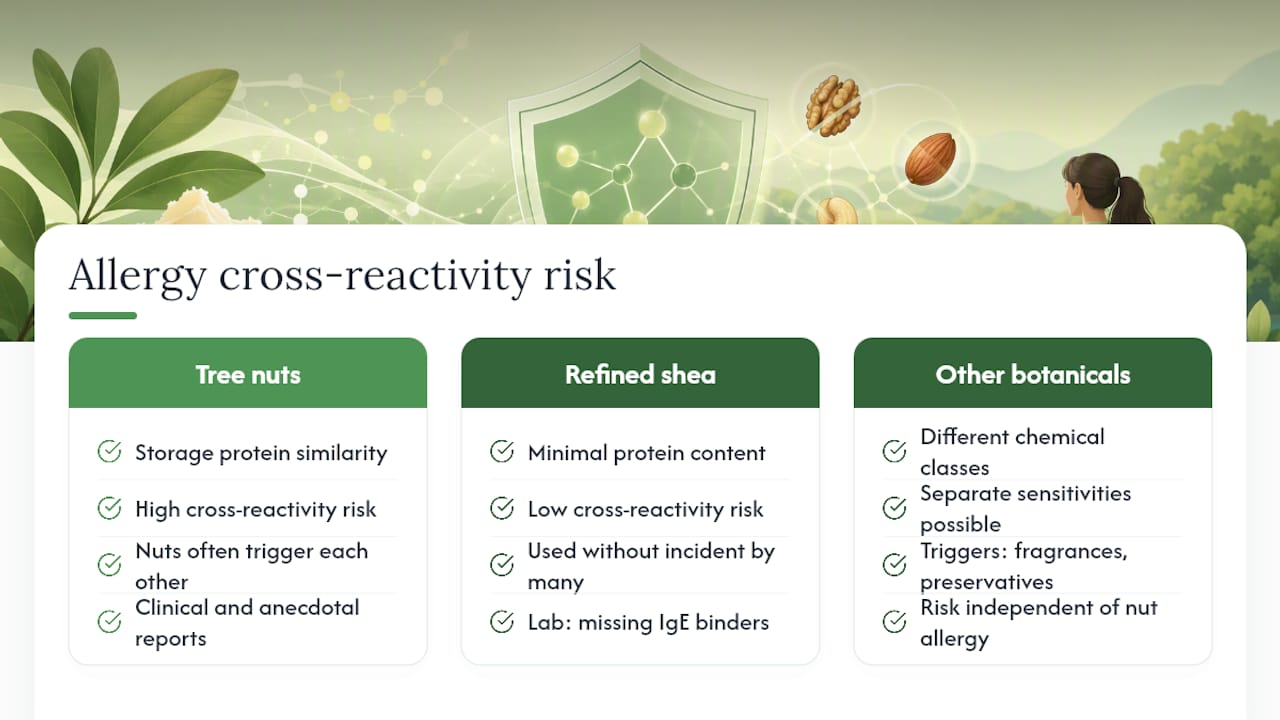
Cross-reactivity is one of the more confusing corners of allergy science, and shea sits in an unusual spot. True tree nuts like almonds, cashews, and walnuts share structurally similar storage proteins, which is why a person allergic to one often reacts to several others. Shea butter doesn’t fit that pattern the same way.
Allergist guidance from Food Allergy Canada points out that shea carries low cross-reactivity risk with peanuts and true tree nuts, largely because refined shea butter’s protein content is so minimal to begin with. Many people already living with diagnosed peanut or tree nut allergies have used shea-containing lotions, soaps, and packaged foods for years without incident, an anecdotal pattern that lines up with the lab findings on missing IgE-binding proteins.
That said, cross-reactivity concerns aren’t limited to other nuts. Some botanical ingredients unrelated to shea, like certain plant resins or seed oils used in “natural” skincare blends, can trigger separate sensitivities that have nothing to do with nut allergy at all. If you react to a shea-based product, the actual trigger might be a fragrance compound, a preservative, or another botanical extract in the formula rather than the shea itself.
The practical takeaway: a nut allergy diagnosis doesn’t automatically predict a shea reaction, and a reaction to a shea product doesn’t automatically confirm shea is the culprit. Reading the full ingredient list, not just the headline ingredient, gives you a much clearer picture than assuming guilt by association.
If You’ve Had a Reaction: Managing Shea Sensitivity Long Term
A one-time bad reaction doesn’t necessarily mean you’re locked out of every product containing shea forever. Management starts with figuring out what actually happened, then building habits around that answer.
If an allergist confirms a genuine IgE-mediated allergy, and current evidence suggests this is rare, the standard long-term approach mirrors other food and contact allergies: strict avoidance of the confirmed trigger, carrying prescribed emergency medication such as an epinephrine auto-injector if systemic reactions occurred, and periodic follow-up with your allergist to reassess as formulations and exposure change over time.
For the more common scenario, contact irritation or mild dermatitis, management looks different. Switching to fragrance-free, minimally processed formulas, introducing new products one at a time instead of layering several at once, and keeping a simple reaction log (product, amount, timing, symptoms) all help you and your dermatologist identify patterns faster.
Topical corticosteroids or antihistamines can calm an active flare, but they’re a short-term tool, not a long-term fix. If reactions keep recurring across different product lines, that pattern itself is diagnostic information worth bringing to an allergist rather than something to just push through.
The goal isn’t necessarily lifetime avoidance of an entire product category. It’s identifying your actual trigger with enough confidence that you can shop with clarity instead of guesswork.
Could Impurities, Not Shea Itself, Be Causing Your Reaction?
Shea butter itself has a strong safety record, but the product you bought isn’t always pure shea butter. Manufacturing, sourcing, and packaging all create opportunities for something other than the shea to cause a reaction.
Cross-contact during processing is the most likely culprit. Facilities that handle multiple nut-based ingredients, or shea alongside actual tree nuts like almond or cashew oil, can introduce trace protein residues into a shea product that wouldn’t otherwise contain any. This is a facility and supply-chain issue, not a shea-specific one, and it’s a big part of why allergist guidance consistently recommends checking labels for allergen advisory statements rather than assuming any two “shea butter” jars are chemically identical.
Additives are the other common source. Fragrance compounds, preservatives, essential oils, and colorants blended into finished lotions or butters can each trigger their own contact reaction, completely independent of the shea. If you’ve reacted to a scented shea body butter but tolerated a fragrance-free one just fine, that’s a strong clue pointing away from the shea itself.
Storage and oxidation matter too, though they’re less discussed. Shea butter that’s gone rancid or been stored improperly can develop irritant compounds that have nothing to do with allergy but still cause redness or discomfort. If a product smells off or has changed texture and color, treat that as a quality issue rather than trying to patch-test your way past it.
Applying Shea Butter on Skin vs. Eating It: Does the Risk Change?
The route of exposure genuinely shifts the risk profile, and it’s worth understanding both directions.
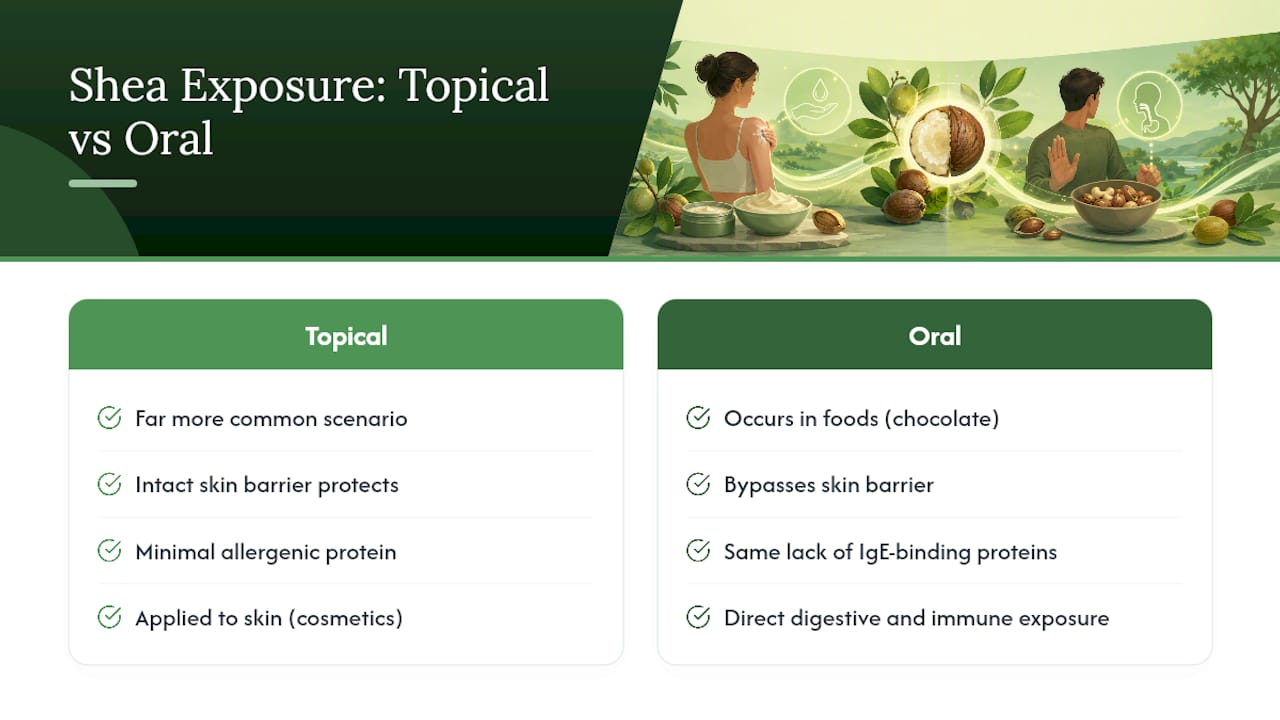
Topical use is the far more common scenario for shea, and it’s also the one with the strongest safety data behind it. Intact skin is a solid barrier, and refined shea butter’s minimal protein content means there’s very little allergenic material available to cross that barrier in the first place. This is why dermatology and cosmetic use of shea has such a clean track record even among people with diagnosed nut allergies.
Ingestion is a different conversation, mostly because oral exposure bypasses the skin barrier and delivers material directly to the digestive and immune system. Shea butter shows up as an ingredient in chocolate, baked goods, and some processed foods, and while the same lack of IgE-binding proteins applies, allergists generally recommend more caution here for anyone with a severe, confirmed tree nut or peanut allergy. If ingestion is your specific concern, that’s exactly the situation where a supervised food challenge or a direct conversation with your allergist adds real value, more than it would for a lotion you’re applying to unbroken skin.
The practical rule of thumb: topical exposure carries the lower theoretical risk of the two, and it’s the exposure route most people are actually asking about when they raise concerns about shea butter allergy.
Jeffi’s Perspective: How We Think About Allergen Safety in Formulation
We built our Bug Bite Relief line and our whipped body butters and lotions to be Non-GMO Project verified, because sensitive-skin customers deserve to know exactly what’s going into a product before they trust it near broken or irritated skin. Formulating for people who’ve had reactions before means taking labeling seriously, not treating it as a checkbox. The evidence on refined shea butter is reassuring, but reassurance and transparency aren’t the same thing, and we think you deserve both.
— Jeffi
Trying Jeffi’s Shea-Based Products the Safe Way
If you’ve read this far and feel reassured about refined shea’s safety record, you might be ready to try a formula built around it. Jeffi’s whipped body butters use Non-GMO Project verified ingredients, so you know exactly what’s going into every jar, no vague “natural blend” labeling to decode.

Our lotions and butters are made for people who want real moisture without guessing what triggered their last reaction. That said, no formula is a substitute for your own precautions: patch-test any new product on your inner arm for 48 hours, and if you have a severe, confirmed nut allergy, check with your allergist before adding shea-based skincare to your routine. Ready to see the full lineup? Browse Jeffi’s natural skincare and repellent products and start with a small size while you test how your skin responds.
Sources
- Shea Nut Butter | Food Allergy Research & Resource Program
- Shea butter contains no IgE-binding soluble proteins
- Ask the allergist – June 2026
This article is general information, not a substitute for advice from a qualified doctor. Consult a qualified healthcare professional about your own circumstances before acting on anything here.