

Always patch test a new skincare product before applying it to your face or body. Dab a quarter-sized amount on a clean, inconspicuous spot like your inner forearm, then leave it alone and watch for 7 to 10 days, since the American Academy of Dermatology and clinical dermatology sources agree that allergic reactions can take days to show up. If you notice burning, blistering, or swelling that spreads, stop immediately and wash the area.
TL;DR:
- Patch tests should be conducted on areas like the inner forearm or behind the ear and monitored over 7 to 10 days for delayed allergic reactions.
- Use a quarter-sized amount of product, reapply or leave it in place as directed, and log any changes to identify potential sensitivities accurately.
- Reactions such as redness, swelling, or blisters indicate a positive test; severe symptoms like difficulty breathing require urgent medical attention.
- Dilute essential oils and potent actives before testing, especially during pregnancy, to minimize the risk of irritation or allergic responses.
- Keep a record of reactions and images, and consult a healthcare professional if symptoms worsen or recur after testing.
Table of Contents
- How to Patch Test Skincare Products, Step by Step
- How Long Should a Patch Test Take?
- Where to Test and How to Adjust by Product Type
- What Does a Skin Reaction Actually Look Like?
- What to Do If Your Patch Test Reaction Flares Up
- Ingredients That Cause the Most Skincare Reactions
- How Jeffi Formulates and Tests Its Own Products
- A Realistic Note on Testing and Record-Keeping
- Try Jeffi’s Tested-Gentle Skincare Line
- Sources
How to Patch Test Skincare Products, Step by Step
You don’t need special equipment for a home patch test, just patience and a spot on your skin you can leave undisturbed for a week or more. The goal is to expose a small area to the product the same way it would be used in real life, then watch closely.
Here’s the process dermatologists and health sources recommend:
- Choose your test area. The inner forearm or behind the ear works well for most leave-on products because the skin is thin and reactions show up clearly.
- Apply a small, honest amount. Use roughly a quarter-sized dab, not a token smear. Too little product won’t reveal how your skin actually responds.
- Leave it undisturbed. Don’t wash, scrub, or cover the spot with tight clothing. Avoid layering other new products on top of it.
- Reapply once daily for rinse-off products (cleansers, masks) and leave leave-on products (serums, lotions, oils) in place without reapplying unless directed.
- Check twice daily. Morning and night, glance at the spot for redness, bumps, or itching.
- Log what you see. A quick phone photo with the date beats memory, especially if a mild reaction develops slowly.
- Watch for 7 to 10 days before applying the product anywhere else, per guidance from Medical News Today.
For essential oils, dilute first. Mix a drop or two into a carrier oil like jojoba or sweet almond oil before testing, since undiluted oils are far more likely to irritate or sensitize skin, according to Healthline’s patch test guidance. The same caution applies to potent actives like retinoids or high-percentage acids: test a lower concentration first, then work up once you know your skin tolerates it.
Pro Tip: Test one new product at a time. If you introduce three products at once and react to one, you’ll have no idea which ingredient caused it.
How Long Should a Patch Test Take?
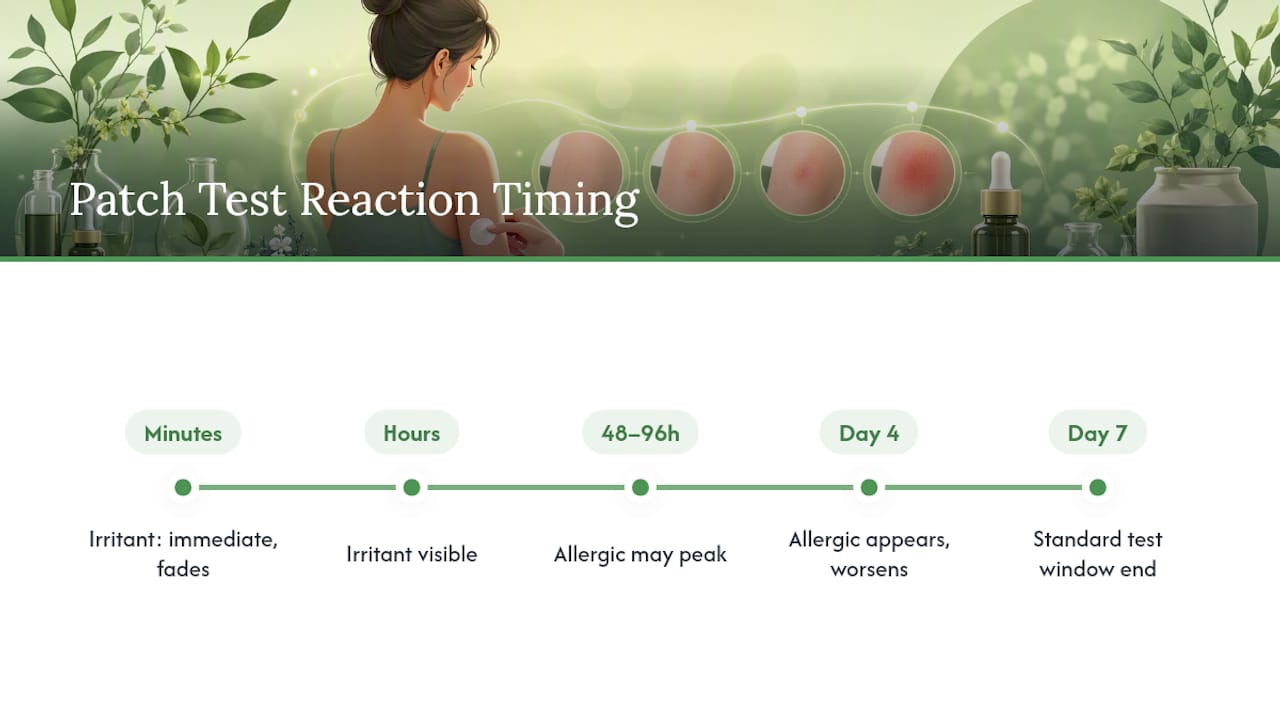
Seven to 10 days is the standard window, and it’s not an arbitrary number. Allergic contact dermatitis, unlike a simple irritation, depends on your immune system building a response over time. That process, explained in clinical reviews of contact dermatitis, can take days to develop after first exposure.
Irritant reactions tend to show up fast, often within minutes to hours, and look like stinging or redness that fades once you remove the product. Allergic reactions frequently show up later, sometimes not until day 4 or 5, and tend to intensify rather than fade. That’s the entire reason for the longer window: a 24-hour test might miss a real allergy entirely.
Rinse-off products (cleansers, shampoos) usually need less contact time since you’re not leaving them on skin for hours. But if you notice anything alarming at any point, don’t wait out the full window; stop right away.
Where to Test and How to Adjust by Product Type
Not every product deserves the same test spot or the same handling. Facial products, body lotions, and essential oils behave differently on skin, so the location and method should shift with them.
- Inner forearm: the go-to spot for most leave-on lotions, body butters, and serums, since the skin is accessible and reactions are easy to see.
- Behind the ear or jawline: useful for facial products, mimicking the thinner, more reactive skin found on the face.
- Inner elbow (bend of the arm): a solid backup spot, especially for rinse-off products you’ll wash after a short contact period.
- Rinse-off formulas: apply, wait 1 to 2 minutes as directed, rinse, then check the spot over the following days just as you would a leave-on product.
- Potent actives (retinoids, acids): test a diluted or lower-strength version first, not the full-strength product.
- Essential oils: always dilute with a carrier oil before testing, and treat lavender and tea tree oil with the same caution as less familiar oils. DermNet NZ documents sensitization cases with oils many people assume are automatically gentle.
If you’re pregnant, extra caution applies to essential oils specifically. Oils like clove, cinnamon, and wintergreen carry higher risk for irritation, and some are best avoided entirely during pregnancy, a point echoed in research on essential oils during pregnancy.
What Does a Skin Reaction Actually Look Like?
Redness, itching, small bumps, blistering, swelling, or hives at the test site all count as reactions worth taking seriously. Mild pinkness that fades within an hour is often just irritation, harmless and temporary. But anything that intensifies, spreads beyond the test spot, or lingers past a day or two starts to look more like allergic contact dermatitis, not simple irritation.
The distinction matters because irritation usually resolves once you stop the product, while an allergic response can escalate with continued exposure. One clinical distinction worth knowing: allergic contact dermatitis often peaks at 48 to 96 hours after exposure, the same window in-office patch testing uses to read results.
Some signs mean stop everything and get help immediately: trouble breathing, swelling of the face, lips, or throat, or hives spreading rapidly across your body. These point toward a more serious allergic response and need urgent medical attention, not a wait-and-see approach.
What to Do If Your Patch Test Reaction Flares Up
A positive patch test isn’t a crisis, but it does call for a clear response. The American Academy of Dermatology recommends stopping use right away and simplifying your routine until skin calms down.
- Stop applying the product immediately, even if the reaction seems mild.
- Wash the area gently with lukewarm water and a fragrance-free cleanser; skip hot water and scrubbing.
- Apply a bland emollient like plain petroleum jelly to soothe the skin barrier while it recovers.
- Use a cold compress for comfort, and consider a short course of over-the-counter hydrocortisone or an oral antihistamine if itching is significant, following package directions.
- Book a dermatologist or allergist visit if the reaction is severe, spreads widely, or keeps recurring with different products; in-office patch testing uses standardized allergen panels read at 48 to 96 hours to pinpoint the exact trigger.
Ingredients That Cause the Most Skincare Reactions
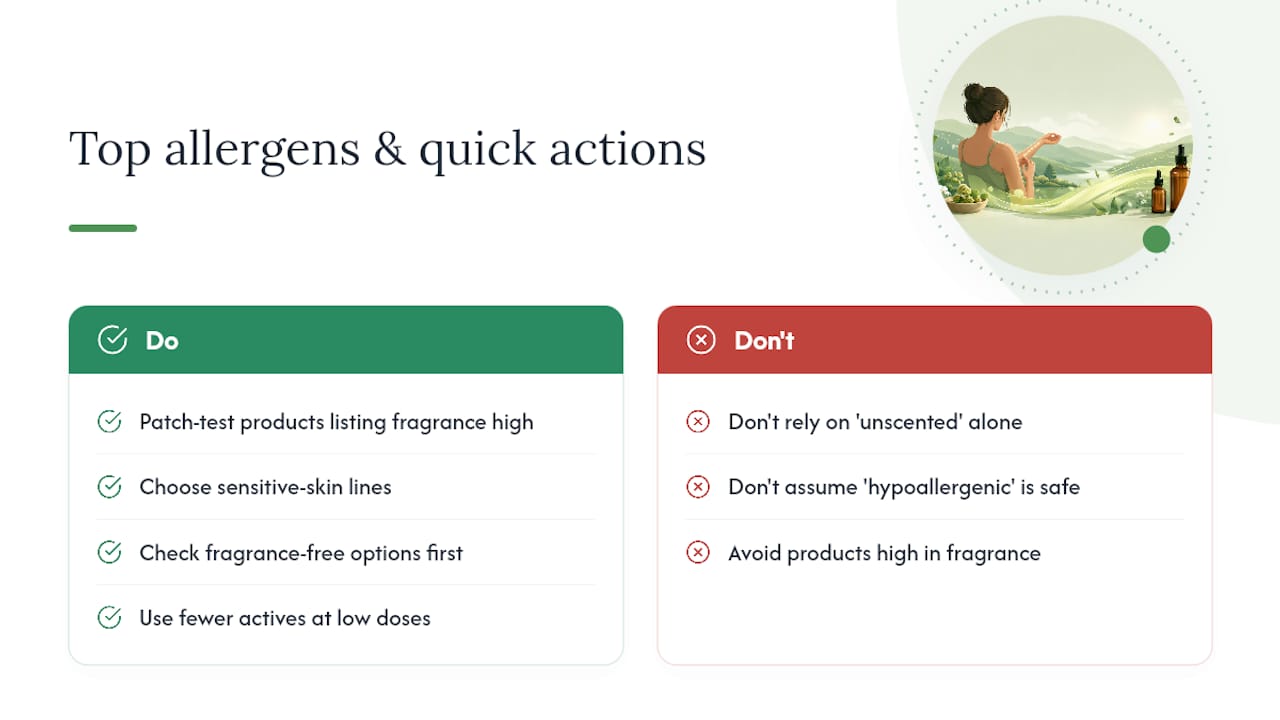
Fragrance tops the list of cosmetic allergens, followed by certain preservatives, propylene glycol, some plant-derived oils, and synthetic dyes, according to the AAD’s overview of contact dermatitis. If a product lists “fragrance” or “parfum” high on its ingredient list, treat it as a higher-risk candidate for testing.
“Fragrance-free” and “unscented” aren’t the same thing. Unscented products often contain masking fragrances to cover raw material smells, while fragrance-free products skip added scent entirely. “Hypoallergenic” carries no regulated definition either; it’s a marketing term, not a guarantee. Choosing sensitive-skin lines, checking fragrance-free options before buying, and favoring fewer active ingredients at lower concentrations all reduce your odds of a reaction.
How Jeffi Formulates and Tests Its Own Products
Jeffi’s hand and body lotions carry Non-GMO Project verification, and the DEET-free repellent balms skip synthetic pesticides in favor of natural ingredients. Even natural formulations deserve a patch test. For whipped body butters, apply a dime-sized amount to your inner forearm once daily and watch for 7 to 10 days, same as any leave-on product, before working it into your full routine.
A Realistic Note on Testing and Record-Keeping
Patch testing lowers risk, it doesn’t erase it. Skin can sensitize to something later even after a clean test. Keep photos and a short log of product names and ingredients, and see a clinician if reactions repeat or worsen.
— Jeffi
Try Jeffi’s Tested-Gentle Skincare Line
Jeffi’s whipped body butters and hand and body lotions carry Non-GMO Project certification, so you’re working with recognizable, natural ingredients rather than a long list of synthetic fillers.

That doesn’t mean skip the test. Apply a dime-sized amount of any whipped body butter to your inner forearm, follow the same 7 to 10 day check-in from this guide, and you’ll know exactly how your skin handles it before it becomes part of your daily routine. Pair a butter with one of Jeffi’s DEET-free balms in a bundle for outdoor season, or browse the full Jeffi lineup to find the texture that fits your skin.
Sources
For primary guidance beyond this article, check the AAD’s own testing instructions, Healthline’s self patch test walkthrough, and gentle-cleansing options like ZERO’s sensitive skin wipes for cleaning irritated skin post-reaction.
This article is general information, not a substitute for advice from a qualified doctor. Consult a qualified healthcare professional about your own circumstances before acting on anything here.