

Choose skincare brands that carry third-party non-GMO verification, not just a “non-GMO” claim printed on the label. A logo from the Non-GMO Project, NATRUE, or Certified Non-GMO by AGW means an independent group checked the supply chain, not just the marketing copy. Some brands’ hand and body lotions, whipped body butters, and sugar scrubs carry Non-GMO Project verification, making it a solid starting point if you want proof instead of a promise. Keep reading to see exactly how to check that proof for yourself.
TL;DR:
- Only third-party verified certifications like Non-GMO Project, NATRUE, or AGW guarantee actual supply chain testing and documentation for non-GMO claims.
- Labels claiming “non-GMO” alone are unregulated, and ingredients like soy, corn, canola, and fermentation-derived products often require verification to confirm non-GMO sourcing.
- Over 70% of skincare products contain GMO ingredients, especially derivatives from soy, corn, and sugar beets, which are difficult to identify without third-party confirmation.
- Verification standards promote traceability and ethical sourcing, often resulting in fewer, well-documented ingredients rather than any guaranteed better performance.
- Brands like Jeffi that carry full-line verification with Non-GMO Project seals ensure consistency and transparency across their entire product range.
Table of Contents
- What “Non-GMO” Actually Means for Skincare Products
- Certifications That Actually Verify Non-GMO Claims
- How to Verify a Brand’s Non-GMO Claims Before You Buy
- Ingredient Red Flags Worth a Second Look
- Choosing and Introducing a New Non-GMO Product Safely
- Popular Non-GMO Skincare Brands and What They Offer
- GMO vs. Non-GMO Skincare: Where the Formulation Actually Differs
- Benefits of Non-GMO Skincare Beyond Avoiding GMOs
- How Non-GMO Fits Into the Bigger Clean Beauty Picture
- Recommended Choice: Jeffi and Who It Fits Best
- How to Confirm These Claims Yourself
- Why Verification Beats Vibes Every Time
- Try Jeffi’s Verified Non-GMO Body Care
- Sources
What “Non-GMO” Actually Means for Skincare Products
A lotion can say “non-GMO” on the front and still contain ingredients derived from genetically modified organisms, because the term itself isn’t policed the way it is on food. There’s a distinction between an ingredient made from a GMO crop (like soybean oil pressed from soybeans) and one made by a GMO organism (like an enzyme produced through fermentation with a genetically engineered microbe). Both types typically count under verification standards, though many brands focus mainly on the former.
The Non-GMO Project applies a 0.9% action threshold to body care products, the same limit used for food. Anything above that trace amount requires testing, and high-risk inputs need supplier affidavits before a product can carry the seal. That threshold matters because processed derivatives, like a glycol or a wax pulled from a GMO plant, can travel several steps down the supply chain and lose any obvious trace of their origin by the time they hit an ingredient list.
Watch for these common GMO-risk sources on skincare labels:
- Soy derivatives, including soy lecithin and soybean oil, used as emulsifiers and moisturizing agents
- Corn derivatives, like corn starch, xanthan gum precursors, and corn-derived glycols
- Canola or rapeseed oil, often listed simply as “vegetable oil” on a product label
- Algae and yeast derivatives, increasingly common in fermentation-based skincare actives
- Sugar beet derivatives, sometimes hidden inside “natural” preservative systems
None of these ingredients are automatically a problem. The issue is that you usually can’t tell their origin from the label alone, which is exactly why third-party verification exists.
Certifications That Actually Verify Non-GMO Claims
A seal on a bottle only means something if you know what the certifying body actually checked. Three certifications dominate the non-GMO skincare space, and each one covers different ground.
This matters more for body care than people assume, since over 70% of products on grocery store shelves contain GMOs, and the ingredient overlap between food and body-care supply chains is larger than most consumers realize.
NATRUE takes a broader approach, built for natural and organic cosmetics generally. Its criteria require non-GMO compliance across finished products, starting materials, and even the enzymes or microorganisms used in processing. That last part matters, because a fermentation-derived ingredient can technically be “non-GMO” at the finished-product stage while the microbe that produced it was genetically engineered.
Certified Non-GMO by AGW goes a step further on emerging biotechnology, treating gene-editing techniques as GMO and placing heavy emphasis on supply-chain traceability and finished-product testing.
Here’s the gap that makes all three necessary: the FDA doesn’t regulate marketing terms like “natural” or “organic” for cosmetics the way it regulates food labels. A brand can call a lotion “clean” or “non-GMO” with zero independent check behind it. Third-party certification fills that regulatory gap, and it’s the closest thing you’ll get to an actual audit trail.
How to Verify a Brand’s Non-GMO Claims Before You Buy
Most non-GMO claims on skincare packaging are technically legal and completely unverified. Here’s how to check one before you trust it:
- Look for a certifier logo, not just text. A printed claim with no accompanying Non-GMO Project butterfly, NATRUE mark, or AGW seal is a marketing statement, not a verified one.
- Search the certifier’s product database. The Non-GMO Project and AGW both maintain searchable lists of verified products and brands, so you can confirm a claim in under a minute instead of taking a label’s word for it.
- Check ingredient origins for high-risk crops. If soy, corn, or canola derivatives appear on the ingredient list without a certification seal nearby, treat that as a flag worth investigating.
- Notice when an ingredient is named on the front of the pack. A product that highlights a specific ingredient on the principal display panel, like “with soy extract,” invites stricter scrutiny under most verification standards, since that ingredient becomes central to the product’s identity claim.
- Request documentation when the label doesn’t settle it. Reputable brands can point you to batch testing or supplier affidavits, even if they haven’t pursued formal certification yet.
Pro Tip: Copy this into an email or chat with customer service: “Can you confirm which ingredients in this product are Non-GMO Project verified or covered by NATRUE/AGW certification, and can you share the certificate or verification number?” A brand with real documentation will answer specifically; one relying on marketing language usually won’t.
Ingredient Red Flags Worth a Second Look
Some ingredients deserve extra attention regardless of how clean the rest of the label looks, mainly because their GMO status is easy to obscure through processing.
- Soy lecithin, a common emulsifier that almost always traces back to conventional (often GMO) soybean crops unless sourced specifically otherwise
- Corn-derived glycols, used as humectants and solvents, frequently unlabeled by crop origin
- Canola or rapeseed oils, listed generically as “vegetable oil” in many formulations
- Certain modified starches, used as texture agents in lotions and scrubs
The trickier category is fermentation-derived ingredients. Many modern skincare actives, from hyaluronic acid to certain peptides, come from microorganisms grown in controlled fermentation tanks. The Non-GMO Project treats these microorganisms as high risk and prohibits them unless verified, because a genetically engineered microbe can produce an ingredient that looks chemically identical to one from a conventional strain.
None of this means every soy or corn derivative is automatically disqualifying. A derivative can absolutely earn a place in a verified non-GMO product, but only when a certifier has actually confirmed the sourcing behind it through testing or supplier documentation. The difference between “probably fine” and “actually verified” comes down entirely to whether that paperwork exists.
Choosing and Introducing a New Non-GMO Product Safely
Picking a new skincare product isn’t just about the non-GMO label. It also needs to match what your skin actually needs.
- Match the product type to your concern. A whipped body butter suits dry, rough patches; a lightweight lotion suits daily hydration; a targeted balm suits bug bites or irritation. Prioritize verified options within whichever category fits.
- Patch test before full use. Apply a small amount to your inner forearm and wait 24 to 48 hours. Redness, itching, or swelling means stop; no reaction means it’s likely safe for broader use.
- Start with a small size. Trial sizes or minis let you test compatibility without committing to a full-size product you might not finish.
- Read the return policy before buying. A brand confident in its formulas usually offers a reasonable exchange or refund window.
- Read reviews that specifically mention sensitivity. Star ratings alone tell you little; a review describing a reaction on sensitive skin tells you a lot.
Popular Non-GMO Skincare Brands and What They Offer
The non-GMO skincare space splits roughly into two camps: large natural-beauty brands with broad product lines, and smaller, verification-focused brands built specifically around clean sourcing. Bigger natural-beauty names often carry Non-GMO Project verification on select lines while leaving others uncertified, which means shoppers still need to check product-by-product rather than assuming brandwide coverage. That inconsistency is common enough that checking the certifier’s own database, rather than trusting a company’s general reputation, remains the more reliable move.
Smaller, verification-first brands tend to build their entire catalog around a single certification rather than applying it selectively. Some brands have Non-GMO Project verification covering their hand and body lotions, sugar scrubs, whipped body butters, and bug-bite relief balms as a consistent standard across the line rather than a feature on one flagship product.
Beyond the labels, product lines themselves vary by texture and function. Whipped body butters lean richer and better suited to dry skin or colder months. Sugar scrubs handle exfoliation and rough patches on elbows, knees, and feet. Lotions and pumps work as daily hydration. Knowing which category solves your actual problem matters as much as knowing which brand verified its ingredients.
GMO vs. Non-GMO Skincare: Where the Formulation Actually Differs
The formulation gap between GMO and non-GMO skincare rarely shows up as a dramatic difference in texture or performance. It shows up in sourcing decisions made months before the product ever reaches a lab bench.
A conventional formulator sourcing soy lecithin, corn-derived glycols, or fermentation-based actives typically buys from whichever supplier offers the best price and consistent supply, with GMO origin rarely a purchasing criterion at all. A brand pursuing non-GMO verification has to work backward from the certification requirements, which means qualifying suppliers who can provide affidavits, submitting to periodic testing, and sometimes reformulating entirely when a preferred ingredient’s supply chain can’t be verified.
That sourcing discipline tends to produce shorter, more traceable ingredient lists, not because non-GMO ingredients are inherently simpler, but because verification pressure discourages complex, hard-to-trace derivative chains. It also means non-GMO brands often stick with fewer, well-documented suppliers rather than switching sources opportunistically based on cost.
None of this guarantees a non-GMO product outperforms a conventional one on texture or results. The difference is closer to a paper trail than a formula.
Benefits of Non-GMO Skincare Beyond Avoiding GMOs
Choosing non-GMO skincare pulls in benefits that have nothing to do with genetic modification directly, mostly because verification standards tend to reward better practices across the board.
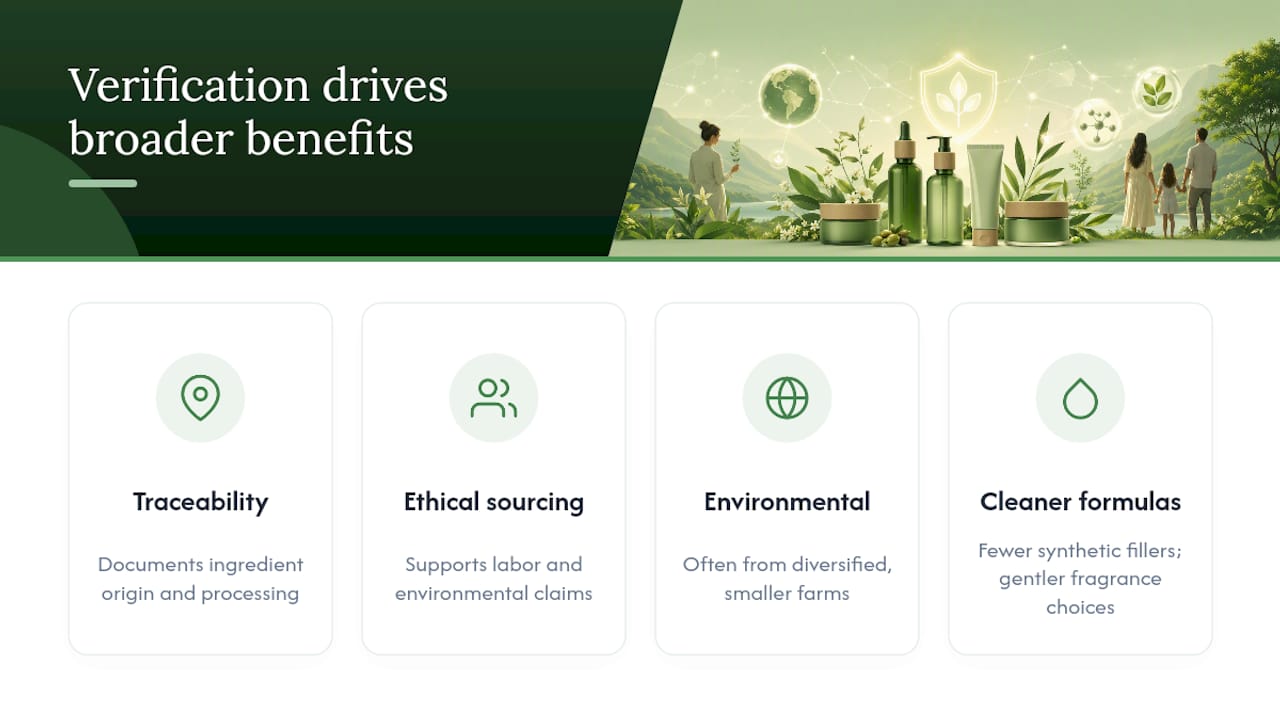
Supply-chain traceability, the backbone of non-GMO certification, forces brands to know exactly where an ingredient originated and how it was processed. That same traceability often supports more ethical sourcing claims, since a brand that can document a soy supplier’s GMO status usually can document labor and environmental practices from that same supplier too.
There’s an environmental angle worth noting as well. Crops grown for verified non-GMO supply chains frequently come from smaller, more diversified farming operations rather than the large monoculture systems that dominate conventional GMO agriculture. That’s not a universal rule, but it’s a common pattern among the suppliers that pursue non-GMO certification in the first place.
Fragrance-conscious shoppers also benefit indirectly. Brands pursuing strict verification standards tend to simplify formulas overall, which often means fewer synthetic fillers and a more considered approach to fragrance and preservative choices. If you’re checking ingredient safety data beyond non-GMO status, EWG’s Skin Deep database is a useful companion resource for cross-referencing specific ingredients.
None of these secondary benefits are guaranteed by a non-GMO seal alone. But the discipline required to earn that seal tends to pull a brand’s entire practice in a more transparent direction.
How Non-GMO Fits Into the Bigger Clean Beauty Picture
Non-GMO verification is one piece of a larger shift in how shoppers evaluate skincare, alongside organic certification, toxic-free formulation, and ingredient transparency generally. None of these standards are interchangeable, even though marketing often blurs them together.
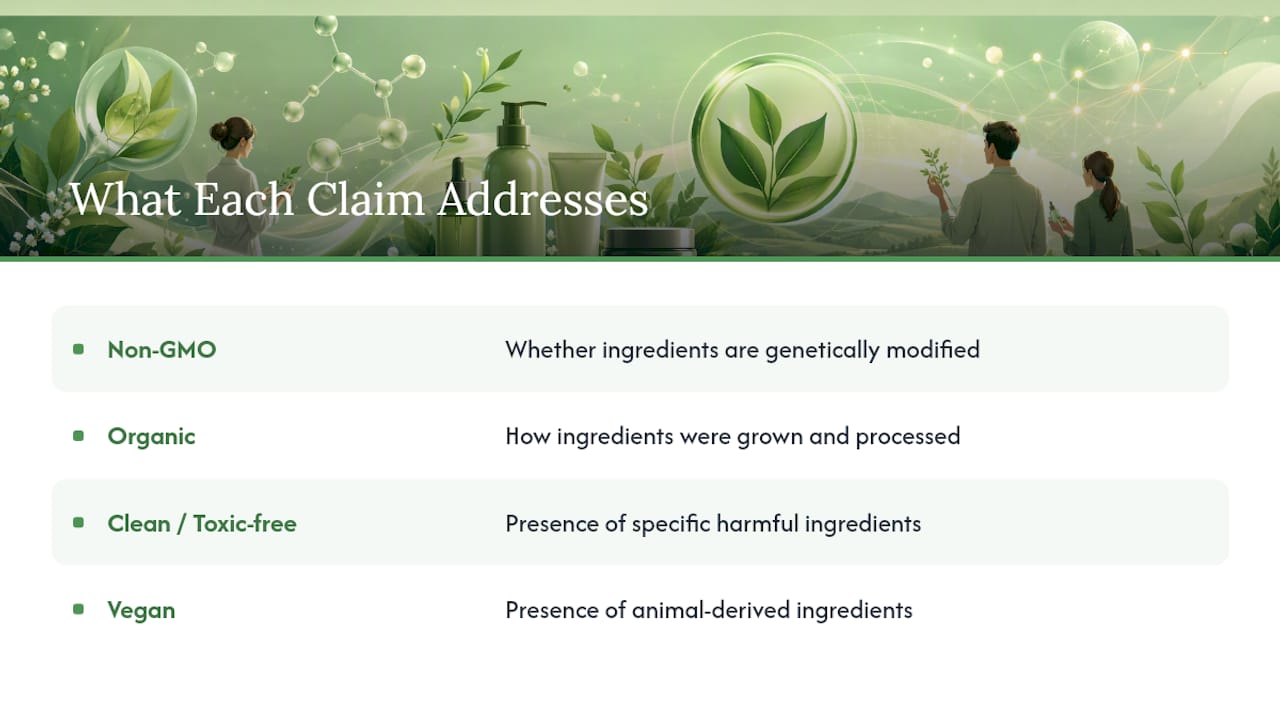
An organic skincare brand focuses on how ingredients were grown and processed, with strict limits on synthetic pesticides and fertilizers. A toxic-free or clean beauty claim usually targets specific ingredient categories, like parabens, sulfates, or certain preservatives, without necessarily addressing GMO status at all. A truly clean beauty product might avoid every synthetic preservative on a banned list and still contain a GMO-derived emulsifier that never gets flagged, because “clean” and “non-GMO” check different boxes entirely.
That’s why the strongest approach layers standards rather than relying on any single one. A vegan non-GMO skincare product, for example, satisfies two separate audiences: shoppers avoiding animal-derived ingredients and shoppers specifically concerned about genetic modification, neither of which the other claim covers on its own.
Retailers have caught onto this fragmentation, too. Some major natural-goods retailers now require third-party verification before a non-GMO claim can appear on shelf tags at all, which has pushed more brands toward actual certification instead of unverified label language. That shift benefits shoppers directly: fewer unverifiable claims, more products you can actually confirm before you buy.
Recommended Choice: Jeffi and Who It Fits Best
Some brands’ hand and body lotions, whipped body butters, sugar scrubs, and bug-bite relief balms carry Non-GMO Project verification, which means the supply chain behind them has gone through the testing and affidavit process this article just walked through, not a marketing team’s word choice.
That verification matters most for a specific kind of shopper. If you have sensitive skin and want documentation behind a “non-GMO” claim rather than a guess, some certified lines give you that paper trail. Some ranges span lightly scented and fragrance-forward options across lotions and scrubs, so you’re not stuck choosing between “clean” and “smells nice.” And if bug bites are a recurring problem, whether from backyard evenings or camping trips, bug-bite relief balms may sit inside the same verified, natural-ingredient framework as the rest of the lineup, rather than being an unrelated add-on category.
If you’re trying Jeffi for the first time, start small. A travel-size lotion or a single sugar scrub lets you patch test and confirm compatibility before committing to a full-size body butter. Give any new product the standard 24 to 48 hour patch test on your inner arm, and only move to broader daily use once you’re confident there’s no reaction. This is especially worth doing if you have known sensitivities or are shopping during pregnancy, when caution around new ingredients matters even more.
How to Confirm These Claims Yourself
Trust in a skincare brand should come from verification you can check, not from a label you have to take at face value. Here’s what to look for and where to look.
- Non-GMO Project verification can be confirmed directly through the Non-GMO Project’s own resources on what verification actually requires, including the testing and affidavit process brands go through.
- Supply-chain claims deserve documentation, not just a sentence on a website. A brand should be able to name its verification body and point to a certificate or listing number if asked.
- Ingredient-level questions are worth cross-checking against a resource like the EWG Skin Deep database when you want more detail than a certification seal alone provides.
Why Verification Beats Vibes Every Time
Most of the “non-GMO” and “clean” language on skincare shelves is unregulated marketing, not fact. That’s not a cynical take; it’s just how cosmetics labeling works in the United States, where the FDA doesn’t police these terms the way it polices food claims. The gap between what a label implies and what a brand can actually prove is where greenwashing lives, and it’s bigger in skincare than most shoppers assume.
Here’s the part that surprises people: a product doesn’t need to be poorly made to fail this test. A well-formulated lotion with genuinely good ingredients can still carry an unverified non-GMO claim, simply because the brand never went through testing or supplier affidavits. Good intentions and good verification aren’t the same thing, and conflating them is exactly how unverified claims spread.
The fix isn’t complicated, even if it takes a few extra minutes. Check the certifier’s database. Ask the brand for documentation. Treat a logo without a traceable standard behind it as decoration, not proof. That habit, applied consistently, does more for your skincare choices than any ingredient trend ever will.
— Jeffi
Try Jeffi’s Verified Non-GMO Body Care
If you’ve read this far, you already know the difference between a marketing claim and an actual verification. Jeffi skips the guesswork by building its entire lineup, hand and body lotions, whipped body butters, sugar scrubs, and bug-bite relief balms, around Non-GMO Project verification from the start, rather than adding a seal to one flagship product and leaving the rest unverified.

That consistency is the practical advantage: you don’t have to check each product separately to see whether this batch of lotion meets the same standard as that jar of body butter, because the verification applies across the line. If dry skin, sensitive skin, or backyard bug bites brought you here, start with a travel-size lotion or a sugar scrub to patch test before committing to a full-size whipped body butter. Browse the full range at Jeffi and pick the product that matches what your skin actually needs this season.
Sources
- GMO Facts — The Non‑GMO Project
- What Non‑GMO Project participants need to know — The Non‑GMO Project
- Cosmetics — FDA