

Non-GMO Project Verified means an independent evaluator checked a product against the Non-GMO Project Standard and confirmed it meets that standard for GMO avoidance through testing, traceability, and supply-chain controls. It’s not a guarantee of zero genetically modified material, but it is the most rigorous third-party check of its kind in North America. Look for the orange and black Butterfly on the package. That’s your visual cue that the work has already been done.
TL;DR:
- Verification primarily covers high-risk crops like corn, soy, and canola, with testing thresholds of 0.9% for food and 5% for animal feed ingredients.
- The process relies on ingredient testing, documentation, segregation, and annual renewal, with spot checks to ensure ongoing compliance.
- The Butterfly label indicates assessed ingredients and supply-chain controls, but cannot guarantee total absence of GMOs due to unavoidable contamination risks.
- GMO testing targets only high-risk ingredients, focusing on supply chain traceability and segregation rather than elimination, making it a practical avoidance standard.
- Organic labels differ significantly, as they address broader farming practices, while Non-GMO Project Verified specifically emphasizes GMO testing and ingredient verification.
Table of Contents
- Non GMO Project Verified Meaning: What the Standard Actually Requires
- How Verification Works: Testing, Audits, and Ongoing Checks
- Which Ingredients Get Tested, and What the Percentages Mean
- What the Butterfly Label Promises, and Where It Stops
- Non-GMO Project Verified vs. Organic: Which Label Answers Which Question
- How to Spot and Verify the Label While You Shop
- The History Behind the Butterfly: How the Non-GMO Project Got Started
- Beyond GMO Testing: Other Rules Baked Into the Standard
- What Consumers and Producers Gain, and Where Critics Push Back
- Why Shoppers Increasingly Trust the Butterfly Mark
- Why Third-Party Verification Matters to Us at Jeffi
- Where to Verify a Non-GMO Claim Yourself
- Sources
Non GMO Project Verified Meaning: What the Standard Actually Requires
The Non-GMO Project is a nonprofit, not a government agency, and it built its own rulebook rather than waiting for federal labeling law to catch up. That rulebook is called the Standard, and it’s the backbone of every Butterfly label you see on a shelf.
Getting verified isn’t a one-time form. Brands work through a structured process that covers several fronts at once:
- Ingredient risk assessment — every input gets classified as high risk, low risk, or not applicable based on whether a GMO version of that crop exists commercially.
- Testing plans — high-risk ingredients need a documented testing protocol, not just a promise.
- Traceability records — brands must show where each ingredient came from and how it moved through the supply chain.
- Segregation practices — facilities must keep verified ingredients physically separate from non-verified ones to avoid mixing.
- Approved technical administrators — a roster of accredited third parties actually does the evaluation, not the Non-GMO Project itself.
The whole system is built around one practical idea: GMO avoidance, not GMO elimination. That distinction matters because complete elimination isn’t scientifically provable at scale, but disciplined avoidance is something a company can actually document and defend.
How Verification Works: Testing, Audits, and Ongoing Checks
Verification doesn’t happen by testing the finished bottle of lotion or the final bag of chips. It happens earlier, at the ingredient level, which is where the process gets more interesting than most shoppers realize.
- Ingredient and lot testing. High-risk raw materials get tested at the point of initial processing, when DNA is most intact and sampling is most representative of the whole batch, according to FoodChain ID’s explanation of the testing process.
- Independent lab work. Technical administrators, accredited outside firms, handle the evaluation. The Non-GMO Project sets the rules; it doesn’t grade its own homework.
- Paperwork and on-site review. Administrators check documentation and, in many cases, inspect facilities to confirm segregation practices match what’s on paper.
- Annual renewal. Verification expires. Brands reapply every year and requalify from scratch.
- Random surveillance testing. Even after approval, the Non-GMO Project’s verification FAQ confirms that spot checks continue, and any failure triggers corrective action before a product can keep the Butterfly.
Pro Tip: If a brand can’t tell you which technical administrator handled its verification, that’s a reasonable reason to ask more questions before you trust the label.
This layered approach explains why the label carries weight with retailers and shoppers alike. It’s not a logo a company slaps on; it’s a standing obligation.
Which Ingredients Get Tested, and What the Percentages Mean
Not every ingredient needs lab testing. The Standard focuses testing dollars and effort on crops where genetically modified versions are widely grown commercially, commonly called high-risk crops. That list includes corn, soy, canola, sugar beets, papaya, and summer squash, along with a handful of others.
For these high-risk ingredients, the Standard sets action thresholds of 0.9% for human food ingredients and 5% for animal feed ingredients, according to FoodChain ID.
An action threshold isn’t a target. It’s the point at which a level of GMO presence triggers corrective steps or disqualifies the ingredient from use. Below that line, a batch can still be considered compliant even with trace contamination, because seed stock and shared farm equipment make absolute purity nearly impossible to guarantee. Those numbers exist because testing has real limits, and supply chains involve shared trucks, silos, and processing lines that no single company fully controls. The threshold approach is a practical compromise: strict enough to mean something, realistic enough to be enforceable.
What the Butterfly Label Promises, and Where It Stops
Here’s where a lot of shoppers get tripped up. The Butterfly doesn’t say “GMO-free.” It can’t, because no credible testing regime can prove the total absence of something at a molecular level across an entire supply chain.
What the label actually communicates:
- The product’s ingredients were assessed and, where high risk, tested against defined thresholds.
- The supply chain has documented traceability and segregation practices in place.
- The brand agreed to ongoing monitoring, not just a single audit.
Contamination risk never fully disappears. Seed can commingle in the field, storage bins get shared, and processing facilities sometimes handle both verified and non-verified goods on the same line, as PCC Markets explains in its overview of the seal. The Standard reduces that risk through testing and segregation; it doesn’t erase it. That’s exactly why third-party checks matter so much here. A brand’s own word about its sourcing is one thing. An outside evaluator confirming it with lab data is another.
Non-GMO Project Verified vs. Organic: Which Label Answers Which Question
These two labels get lumped together constantly, but they answer different questions entirely.
- Organic is broad. It covers pesticide use, synthetic fertilizers, farming practices, and yes, GMO exclusion is part of the standard, but it’s one piece of a much larger picture regulated by the USDA.
- Non-GMO Project Verified is narrow by design. It exists to answer exactly one question: was this product evaluated for genetically modified content using a defined testing and traceability process?
- Verification methods differ too. Organic certification relies heavily on farm inspections and practice audits. Non-GMO Project verification leans on ingredient-level lab testing paired with paper-trail traceability.
When a product carries both labels, you’re getting layered assurance: broad farming-practice oversight from organic certification, plus a dedicated GMO-focused testing regime from the Butterfly. Neither replaces the other, and for shoppers who care specifically about GMO content, the Butterfly is the more direct signal of the two.
How to Spot and Verify the Label While You Shop
Finding a legitimately verified product takes less effort than you’d think once you know what to look for.
- Scan for the Butterfly. It’s a distinctive orange and black monarch icon, usually near the front of the package.
- Check for the project URL. Verified products typically print nongmoproject.org somewhere on the label alongside the mark.
- Cross-reference with the Product Finder. The Non-GMO Project maintains a searchable database where you can confirm a product’s current verification status directly.
- Read the ingredient list. If you spot corn, soy, canola, or sugar beet derivatives without the Butterfly present, that’s worth a second look.
- Favor brands that publish sourcing details. Companies willing to show their supply chain tend to back that transparency up with real documentation.
The History Behind the Butterfly: How the Non-GMO Project Got Started
The Non-GMO Project launched in 2007, founded by a small group of natural food retailers who noticed a gap that federal regulation wasn’t filling. At the time, there was no consistent, verifiable way for a shopper to know whether a product contained genetically modified ingredients, and no unified standard for what “non-GMO” claims should even mean.
Retailers were fielding constant customer questions they couldn’t fully answer, so the founders built a nonprofit structure designed specifically to create a rigorous, third-party verification system rather than relying on brands to self-declare. Since then, the Standard has been updated repeatedly as new genetically engineered crops and traits have entered commercial agriculture, including newer gene-editing techniques that didn’t exist when the program began.
The Butterfly mark grew from a niche natural-foods signal into one of the most recognized certification icons in North American grocery aisles. Its growth tracks closely with rising consumer interest in ingredient transparency generally, not just GMO content specifically. What started as a workaround for a regulatory blind spot has become a de facto industry benchmark, with retailers, personal-care brands, and food manufacturers alike treating verification as a competitive differentiator rather than a niche add-on.
Beyond GMO Testing: Other Rules Baked Into the Standard
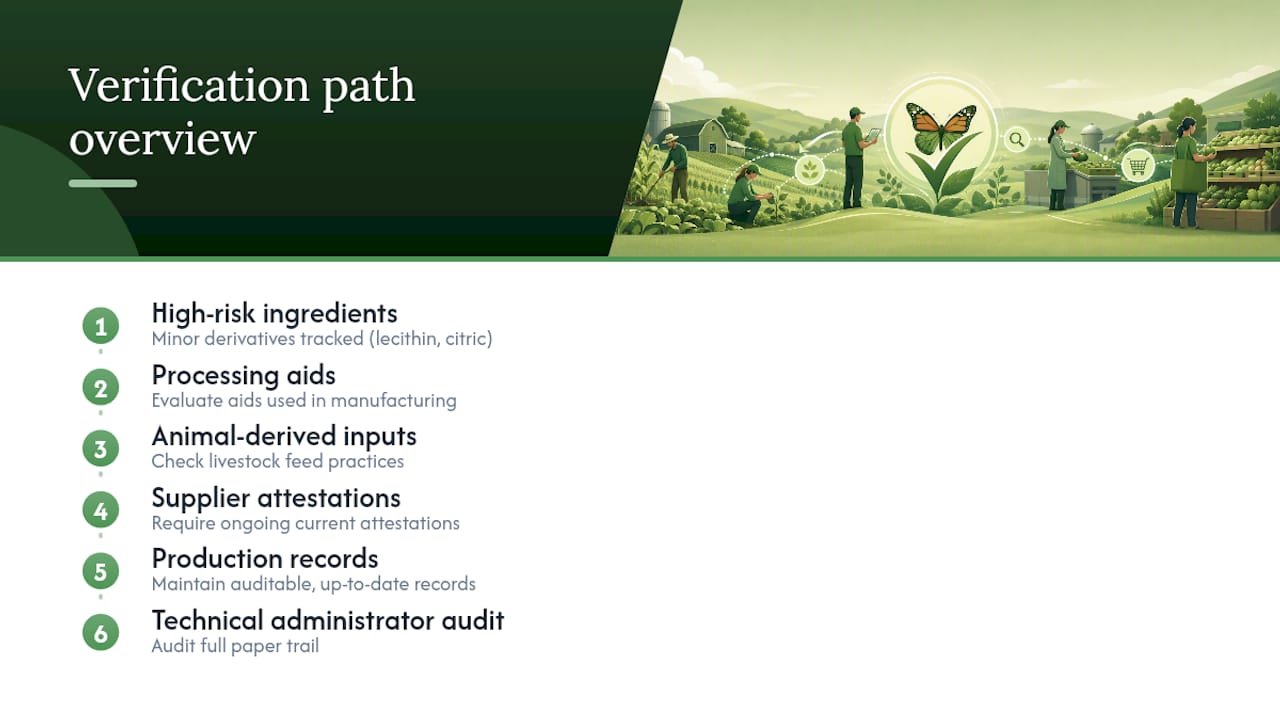
GMO testing gets most of the attention, but the Standard reaches further than lab results. Acceptable ingredient sourcing is part of the evaluation too. High-risk crop derivatives, even minor ones like lecithin or citric acid that can trace back to corn or soy, fall under the same scrutiny as headline ingredients.
Processing aids matter as well. Substances used during manufacturing that don’t appear on the final ingredient label, like certain enzymes or filtering agents, still get evaluated if they touch a high-risk crop somewhere in production. A brand can’t hide a GMO-derived processing aid just because it doesn’t legally need to be listed on the package.
The Standard also addresses inputs that might seem unrelated to genetic engineering at first glance, such as certain livestock feed practices when animal-derived ingredients are involved, and it requires ongoing supplier attestations, not just a one-time declaration. Documentation has to be current, not archived from a previous production cycle.
This broader scope is part of why verification takes real time to complete. A company can’t just test its two or three obvious high-risk ingredients and call it done. Every input, every processing step, and every supplier relationship needs a paper trail that a technical administrator can actually audit, which is exactly the kind of rigor that separates a nonprofit-run verification program from a marketing claim printed without oversight.
What Consumers and Producers Gain, and Where Critics Push Back
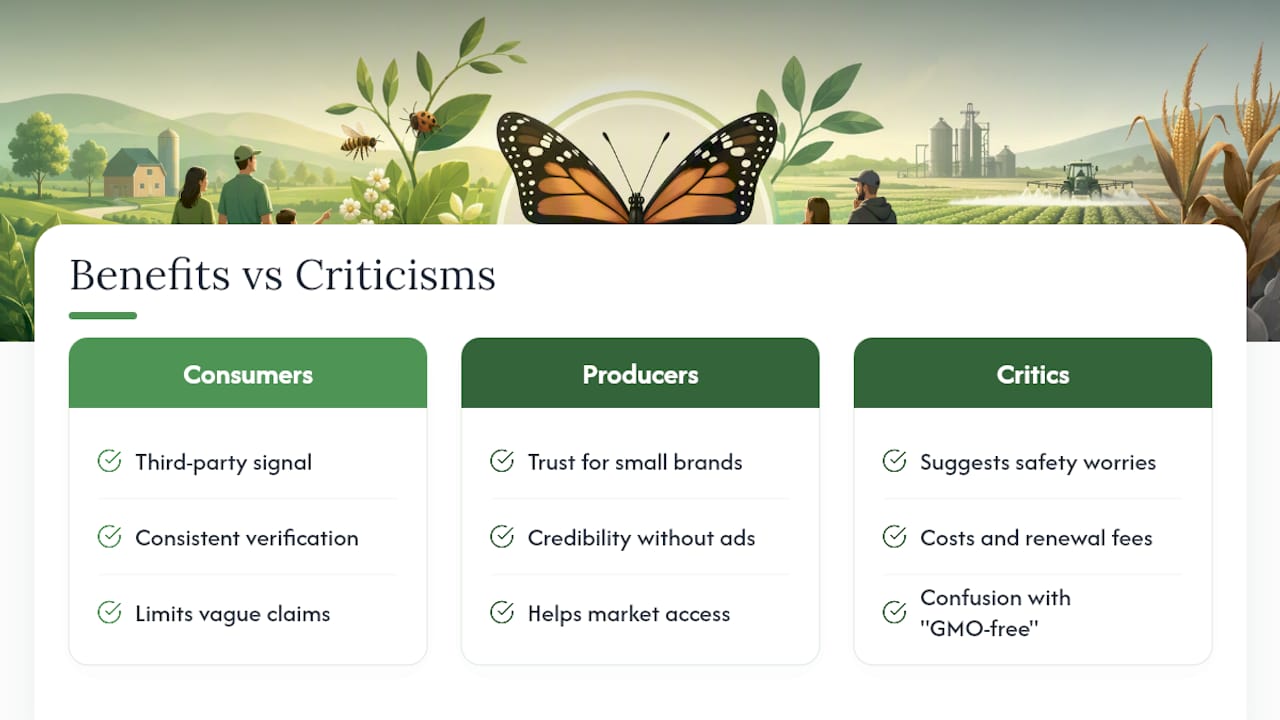
For shoppers, the benefit is straightforward: a consistent, third-party checked signal in a marketplace where “non-GMO” claims could otherwise mean almost anything a marketing team wants them to mean. Independent verification, as Consumer Reports notes, gives that claim actual teeth because manufacturers work with outside certification companies rather than self-certifying.
Producers benefit too, particularly smaller natural-product brands that don’t have the marketing budget to build trust through advertising alone. A recognized third-party mark does some of that trust-building work for them.
Criticism exists, and it’s worth taking seriously. Some scientists argue the label implies a safety concern about GMOs that current research doesn’t support, since regulatory bodies generally consider approved GMO crops safe to eat. Others point out that verification costs and annual renewal fees can be a real burden for small producers, potentially pricing out companies that are otherwise making genuinely careful sourcing decisions. There’s also the ongoing question of consumer confusion between “Non-GMO Project Verified” and “GMO-free,” two phrases that sound interchangeable but mean different things in practice. None of these criticisms erase the value of the verification work itself, but they’re a fair part of the conversation around the label.
Why Shoppers Increasingly Trust the Butterfly Mark
Consumer demand for ingredient transparency has climbed steadily, and the Butterfly has become one of the clearest beneficiaries of that shift. Retailers now stock verified products prominently, sometimes with dedicated shelf tags, because they’ve learned shoppers actively look for the mark rather than stumbling on it by accident.
That trust didn’t happen by accident either. It’s the byproduct of a verification model that requires ongoing surveillance testing rather than a one-time check, which gives the label staying power that a simple self-declared claim never earns. Brands can’t verify once and coast for a decade.
The ripple effect reaches beyond the food aisle. Personal-care and skincare brands have adopted the same verification model, applying ingredient-level scrutiny to lotions, scrubs, and body butters the same way food companies apply it to cereal and snack bars. That crossover reflects a broader pattern: once a verification system proves its rigor in one category, shoppers start expecting it everywhere they spend money on things they put on or in their bodies.
Why Third-Party Verification Matters to Us at Jeffi
We source Non-GMO ingredients for our lotions, body butters, and scrubs because we’d rather have an outside evaluator confirm our claims than ask you to take our word for it. That’s the whole point of third-party verification: it removes the guesswork from clean-label positioning.
For a category like natural skincare and mosquito repellent, where “natural” gets thrown around loosely, a Non-GMO Project Verified mark backed by real ingredient risk assessment and traceability means something concrete. It’s a standard we can point to, not just a phrase we chose ourselves.
— Jeffi
Where to Verify a Non-GMO Claim Yourself
Check the Non-GMO Project Standard directly, browse the Butterfly label page for verification basics, or search the Product Finder for a specific item. For sourcing transparency in personal-care formulation, Formly’s guide to ingredient sourcing breaks down what real supply-chain documentation looks like.
Jeffi carries that same standard into every hand and body lotion, whipped body butter, and sugar scrub we sell, alongside our all-natural, DEET-free repellent balms and roll-ons. If you’re shopping for products that back up their claims with real verification instead of just a nice label, browse Jeffi’s full lineup and see what Non-GMO certified actually looks like on the shelf.
Sources
- The Standard — The Non‑GMO Project
- Non‑GMO Project verification FAQ — The Non‑GMO Project
- GMO testing for Non‑GMO Project verification explained — FoodChain ID
- Seal: Non‑GMO Project Verified — Consumer Reports