

A blistered mosquito bite almost always calls for the same four moves: clean it gently with soap and water, cool it with a compress for 10 to 20 minutes, leave it alone (never pop it), and calm the itch with calamine, hydrocortisone, or an antihistamine. Most of these blisters heal on their own within days. Call a doctor or 911 only if you notice spreading redness, pus, fever, or trouble breathing.
TL;DR:
- People with prior strong reactions, children, and those with allergies are more likely to develop blistering from mosquito bites, but it does not indicate a compromised immune system.
- Proper treatment involves cleaning the area, applying cold compresses, leaving blisters intact, and using over-the-counter antihistamines or topical creams to minimize inflammation and itching.
- Seek medical attention immediately if swelling worsens, spreads, or if there are signs of infection or severe allergic reactions like difficulty breathing or facial swelling.
- Most blistered bites heal within one to two weeks, but scratching or disturbing the blister can prolong healing and increase infection risk.
- Preventing bites with repellents containing DEET, wearing protective clothing, and eliminating standing water are more effective than treatment once a blister forms.
Table of Contents
- Why Some Mosquito Bites Blister Into a Bigger Reaction
- How to Treat a Mosquito Bite Blister Step by Step
- When a Mosquito Bite Blister Needs a Doctor’s Attention
- How Long a Mosquito Bite Blister Takes to Heal
- Preventing Mosquito Bite Blisters Before They Start
- What to Do If a Blister Swells More Than Usual
- Choosing the Right Dressing and How Often to Change It
- Home Remedies That Actually Help vs. Ones to Skip
- Caring for Blistered Bites in Sensitive Areas
- Managing the Itch Without Popping the Blister
- Jeffi’s Take on Aftercare That Respects the Healing Process
- Where Jeffi Fits Once the Medical Basics Are Covered
- Sources
- FAQ
Why Some Mosquito Bites Blister Into a Bigger Reaction
A blister forms when your immune system overreacts to proteins in mosquito saliva, not because the bite is somehow more dangerous than a regular one. When a mosquito feeds, it injects saliva that keeps your blood from clotting long enough for it to finish its meal. Your body reads those saliva proteins as a threat and floods the area with histamine and fluid, and in some people that fluid pools under the top layer of skin instead of just causing a raised bump.
That is largely a matter of individual sensitivity, and blistering is usually a localized inflammatory response rather than a sign of infection or mosquito-borne illness on its own. Doctors sometimes call an extreme version of this reaction “skeeter syndrome,” where swelling spreads well beyond the bite itself and can even mimic a skin infection at first glance. Cleveland Clinic notes that these large local reactions can look alarming but usually respond to antihistamines, with oral corticosteroids reserved for more severe cases.
A few factors make blistering more likely:
- A history of strong reactions to bites in the past
- Younger children, whose immune systems react more visibly to new allergens
- General immune sensitivity or seasonal allergy tendencies
- Repeated bites in the same area, which can compound swelling
None of this means something is wrong with your immune system. It just means yours reacts loudly to a substance most people barely notice.
How to Treat a Mosquito Bite Blister Step by Step
Good mosquito bite blister care follows a simple order: clean, cool, protect, then treat the itch. Skipping the cleaning step is where most people run into trouble, because scratched, dirty skin is exactly how a harmless blister turns into an infected one.
- Wash the area with mild soap and lukewarm water. This clears away sweat, dirt, and bacteria that could turn a minor reaction into a skin infection.
- Apply a cold compress, wrapped in a thin cloth, for 10 to 20 minutes at a time. Longer sessions risk irritating or numbing the skin, so give it a break between applications.
- Leave the blister intact. The skin over it acts as a natural, sterile bandage, and popping it opens the door to bacteria.
- Apply a thin layer of calamine lotion or 0.5 to 1% hydrocortisone cream to calm inflammation and itching on unbroken skin.
- Take a non-sedating antihistamine like cetirizine or loratadine if the itching is intense or widespread.
- If the blister breaks on its own, clean it gently, dab on a thin layer of petroleum jelly, and cover it with a sterile, non-stick dressing. Change that dressing daily and watch for changes in color or drainage.
This sequence lines up closely with Mayo Clinic’s first-aid guidance for insect bites, which flags scratching as the number one cause of secondary infection. The CDC’s own advice follows the same basic pattern of washing, icing, and using calamine or over-the-counter anti-itch treatments.
Skip anything abrasive or unproven on skin that has already broken open. Baking soda paste gets recommended for unbroken bites, but several clinical sources specifically advise against it once the skin barrier is gone, since it can irritate already-inflamed tissue.
Pro Tip: Keep a small kit of calamine lotion, hydrocortisone cream, and individually wrapped sterile dressings in your first-aid bag during mosquito season. Having them ready means you treat the bite in the first hour, before the itch-scratch cycle even starts.
When a Mosquito Bite Blister Needs a Doctor’s Attention
Most blistered bites never need a clinician, but a handful of warning signs mean you should not wait it out. Call 911 or go to an emergency room immediately if you notice any signs of a severe allergic reaction:
- Difficulty breathing or a tight feeling in the throat
- Swelling of the face, lips, or tongue
- Dizziness, fainting, or a rapid heartbeat spreading beyond the bite site
Infection is a separate concern, and it usually builds more gradually than an allergic reaction. Watch for these signs of a bacterial infection like cellulitis:
- Redness that keeps expanding outward from the bite
- Warmth, increasing pain, or red streaking running up a limb
- Pus or cloudy drainage from the blister
- Fever or tender, swollen lymph nodes nearby
One in five people report they’ve experienced a mosquito bite that later developed signs of infection after scratching broke the skin, which is exactly why leaving the blister alone matters so much. If a clinician does examine an infected bite, expect a course of topical or oral antibiotics for cellulitis, a short round of oral steroids for a severe skeeter-syndrome flare, or a referral to an allergist if large reactions keep recurring.
How Long a Mosquito Bite Blister Takes to Heal
A blistered mosquito bite typically starts calming down within a few days, and most fully resolve within one to two weeks. The exact timeline depends on the size of the blister and how much you disturb it while it heals.
Scratching is the single biggest thing that drags healing out. It reopens skin, invites bacteria in, and raises the odds of scarring or a dark mark left behind once the bite fades, a change dermatologists call post-inflammatory hyperpigmentation.
A few habits speed things along:
- Keep the area clean and covered if the blister has broken open
- Resist scratching, even when the itch is intense (an antihistamine helps here)
- Moisturize the skin around the healed bite once it has closed, rather than while it is still open
- Avoid picking at any scab that forms afterward
Give a bite closer to two weeks before you worry that healing has stalled. If it looks worse rather than better after several days, treat that as a signal to check for infection.
Preventing Mosquito Bite Blisters Before They Start
The most reliable way to avoid blister care altogether is to keep mosquitoes from biting in the first place. An EPA-registered repellent containing DEET, picaridin, or IR3535 remains the most consistent defense, and DEET concentrations between 20 and 50% provide several hours of protection depending on the formula and activity level.
For extra protection during peak season, add these layers:
- Treat clothing (not skin) with permethrin, or buy pre-treated gear, for a barrier that lasts through several washes
- Wear long sleeves and pants during dawn and dusk, when mosquitoes are most active
- Dump standing water around your yard, gutters, and containers where mosquitoes breed
- Use screens on windows and doors instead of relying on repellent alone indoors
If you know you tend toward large, blistering reactions, build your prevention plan around avoiding bites altogether rather than just treating them afterward. That might mean a stronger repellent, tighter-woven clothing, or, if reactions keep recurring, a conversation with an allergist about what is actually happening under your skin. Resources like this breakdown of how repellents work can help you understand which option fits your routine before the season starts.
What to Do If a Blister Swells More Than Usual
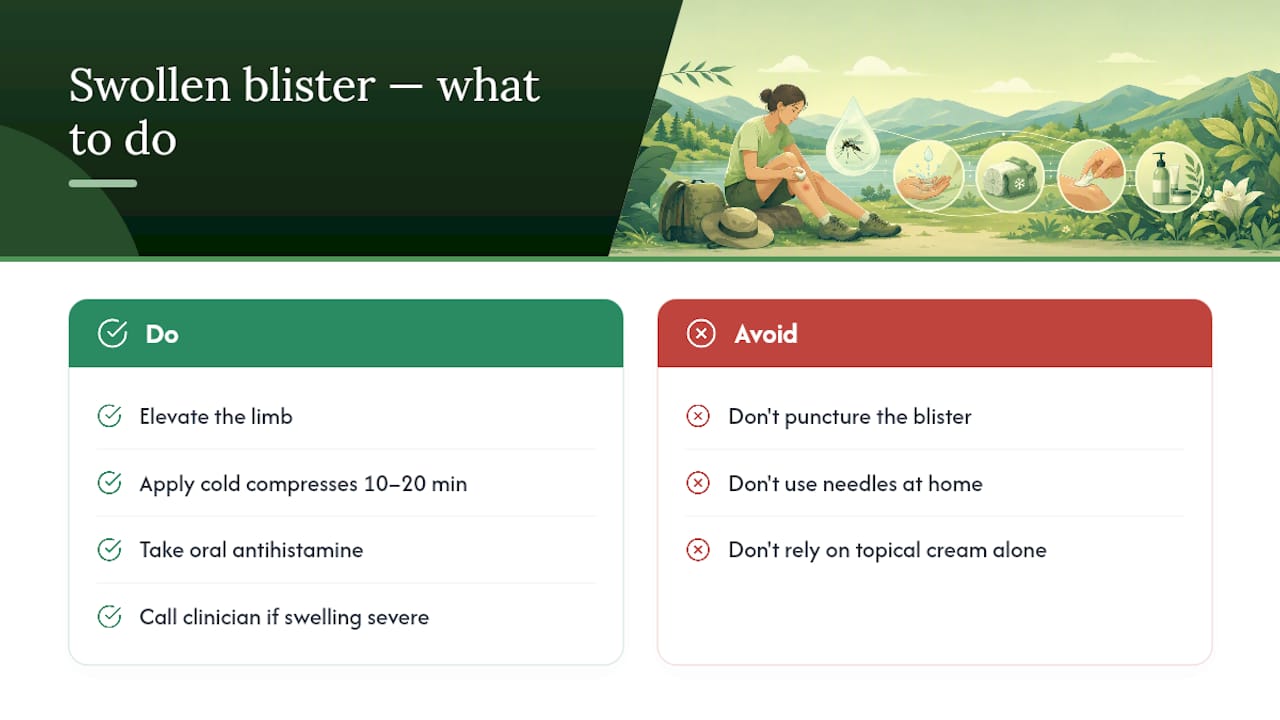
A blister that keeps growing usually means fluid is still accumulating under the skin, and the goal is to ease that swelling without breaking the seal that protects it from bacteria. Elevating the affected limb, if the bite is on an arm or leg, helps fluid drain away from the site using gravity instead of pressure.
Continue cold compresses in 10 to 20 minute sessions spaced a few hours apart, since cold reduces blood flow to the area and slows further fluid buildup. An oral antihistamine works from the inside to calm the histamine response that is driving the swelling in the first place, and it often does more for a stubborn, puffy bite than any topical cream alone.
Resist the urge to drain a swollen blister with a needle at home. That instinct makes sense. Watching a bite balloon feels like something needs to be let out. But an unsterilized needle introduces exactly the bacteria that turns a self-limited reaction into a real infection, and even a clean needle removes the natural barrier the blister was providing.
If swelling is severe enough that you are considering draining it yourself, that is actually the moment to call a clinician instead. A provider can drain a large blister under sterile conditions if it is genuinely warranted, and they can tell the difference between ordinary swelling and the early signs of skeeter syndrome or cellulitis that call for antihistamines or antibiotics. Reducing swelling safely usually comes down to patience, cold, elevation, and antihistamines, not intervention.
Choosing the Right Dressing and How Often to Change It
An intact blister does not need a dressing at all. Its own skin is the best barrier available, and covering it is optional unless it sits somewhere prone to friction, like the back of a knee or under a waistband.
Once a blister ruptures, that changes. A thin layer of petroleum jelly followed by a sterile, non-stick dressing keeps the wound moist enough to heal without letting bacteria in, and Healthline’s guidance on ruptured bites specifically recommends this combination over leaving broken skin uncovered.
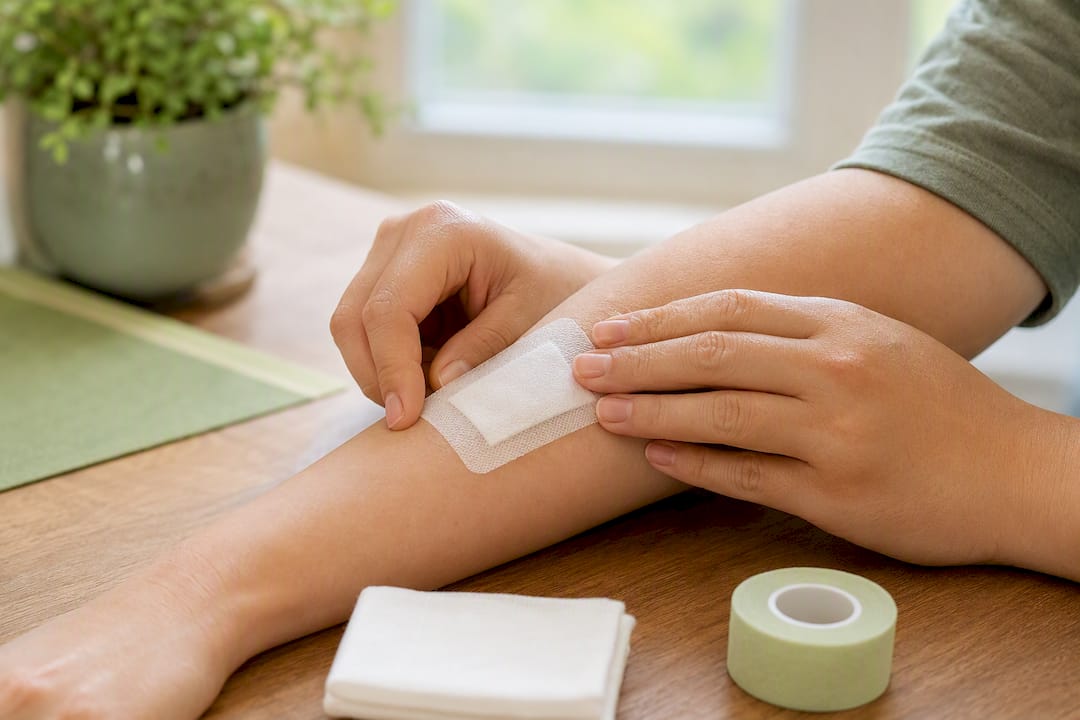
Change that dressing once a day, or sooner if it gets wet, dirty, or starts to peel at the edges. Each change is a chance to check for the early signs of infection covered above; catching redness or warmth on day two is far better than discovering it on day five.
Skip adhesive bandages that stick directly to broken skin, since peeling them off can tear delicate new tissue underneath. A gauze pad secured loosely with paper tape, or a specialty non-stick pad, causes far less disruption when it is time to change it. Avoid anything heavily fragranced or medicated beyond the petroleum jelly layer while the wound is still open, since fragrance and active ingredients both have a chance to irritate skin that has no barrier left to protect it.
Home Remedies That Actually Help vs. Ones to Skip
Not every home remedy for bites deserves a place in your medicine cabinet, and the difference usually comes down to whether the skin is broken. Pure aloe vera gel is genuinely useful on unbroken, blistered skin. It cools the area and has a mild anti-inflammatory effect that many people find soothing alongside calamine or hydrocortisone.
Honey has some evidence behind it as a wound-supportive dressing in clinical settings, but that typically involves medical-grade honey applied under supervision, not a spoonful from the pantry pressed onto an open blister. Treat that one as unproven for home use until skin has fully closed.
Baking soda paste shows up constantly in bug bite advice, and the CDC does list it as an option for reducing itch on unbroken skin. The moment that skin breaks, though, several clinical sources specifically caution against it, since the abrasive paste can irritate already-inflamed, exposed tissue.
Vinegar sits in the same category. Diluted vinegar soaks get recommended informally for insect bites, but there is no strong reason to apply an acidic solution to broken skin when it is more likely to sting and irritate than to help. The same logic applies to essential oils marketed for itch relief. They can be effective on intact skin in small, diluted amounts, but they carry a real risk of irritation on any wound that has already opened.
The simplest rule holds up well here: soothing, non-abrasive options belong on unbroken blisters, and anything acidic, gritty, or undiluted stays away from open skin entirely.
Caring for Blistered Bites in Sensitive Areas
A blister near the eyes, mouth, or genitals calls for extra caution because the skin is thinner and the consequences of getting it wrong are bigger. Swelling near the eye, in particular, can look dramatic within hours, sometimes closing the eyelid partially or fully even when the underlying reaction is not severe.
Skip hydrocortisone cream near the eyes unless a clinician has specifically told you it is fine, since it can be absorbed differently in that thin skin and, over time, affect eye pressure. A cold compress is still safe and often the most effective option, applied gently with light pressure rather than pressed hard against the socket.
Avoid calamine lotion inside the eyelid area or near the lips and genitals, since these are mucous membranes that react more strongly to topical treatments designed for regular skin. Plain, cool water and a soft cloth do the job of calming irritation without the risk.
Any bite in these locations that causes significant swelling, especially one that partially closes an eye or makes swallowing uncomfortable, deserves a same-day call to a doctor rather than a wait-and-see approach. The reasoning is straightforward: swelling in a confined space, like around the eye socket, has less room to expand safely than swelling on an arm or leg. What looks manageable on a calf can be genuinely concerning on an eyelid, and that difference is worth respecting rather than treating every bite the same way regardless of location.
Managing the Itch Without Popping the Blister
The itch from a blistered bite is often worse than the pain, and that itch is exactly what puts the blister at risk. Scratching feels like relief for about three seconds and then makes everything worse, both because it can tear the blister open and because it triggers more histamine release, which restarts the itch cycle all over again.
Cold is your first line of defense, since it interrupts the itch signal to your brain almost immediately without touching the blister itself. A compress held nearby, rather than pressed directly on the blister, still cools the surrounding skin and takes the edge off.
Calamine lotion and 0.5 to 1% hydrocortisone both work on unbroken skin without adding pressure or friction. An oral antihistamine tackles the itch systemically, which matters most if you have several bites at once and cannot treat each one individually.
Keep fingernails short during an active flare, since even light scratching with a sharp nail edge does more damage than scratching with a blunt one. Covering the bite loosely with breathable fabric, rather than a tight bandage, can also reduce the temptation to scratch by keeping it out of sight and out of reach during the day. None of these measures require touching the blister directly, which is the entire point: relief and protection can happen at the same time.
Jeffi’s Take on Aftercare That Respects the Healing Process
Medical guidelines exist for a reason, and no lotion changes that. What we’ve learned from paying close attention to how skin responds to bites is that the products applied around an active blister matter almost as much as what’s applied on it. A lot of bug bite relief products lean on strong fragrances or active ingredients that are fine for a healed bite but genuinely irritating for one that’s still inflamed or broken.
That is the philosophy behind Jeffi’s Non-GMO, all-natural formulas: support skin, do not fight it. Once a blister has closed or a bite is simply itchy without broken skin, gentle moisturizers can help skin recover its barrier. Applying anything heavily scented or untested, including many essential-oil blends, to still-open skin is a step we would never recommend, regardless of how “natural” the label sounds. Natural does not automatically mean gentle enough for compromised skin.
— Jeffi
Where Jeffi Fits Once the Medical Basics Are Covered
Once you’ve handled the cleaning, cooling, and antihistamines, there’s still the question of what to reach for day after day, especially if mosquito season means new bites every week. That’s where Jeffi’s bug bite relief lotion comes in, formulated without synthetic fragrance or dye for people whose skin reacts strongly to standard drugstore products.

For prevention, some DEET-free repellent balms and roll-ons give you an option that skips the sharp chemical smell of traditional sprays while still creating a barrier against bites before they happen. And for the skin recovery that follows, once any blister has fully closed, Jeffi’s whipped body butters and the Confidence Hand & Body Lotion support the skin barrier without the heavy fragrance load that can make already-irritated skin feel worse.
None of these products replace the medical-first steps in this guide, and none belong on a broken or actively healing blister. They fit in before the bite happens and after the skin has closed. If you have questions about which formula suits sensitive or bite-prone skin, Jeffi’s mosquito repellent FAQ page walks through ingredient details and usage timing. Browse the current lineup and find the combination that fits your routine this season.
Sources
This guide draws on first-aid and dermatology guidance from the CDC, Cleveland Clinic, Mayo Clinic, and Healthline, along with a clinical overview on insect-bite prevention. Each source is linked throughout the article at the specific claim it supports, so you can read the original guidance in full context.
This article is general information, not a substitute for advice from a qualified doctor. Consult a qualified healthcare professional about your own circumstances before acting on anything here.
- Mosquito Bite Blisters: Cause and Treatments (Healthline)
- About mosquito bites | CDC
- Skeeter Syndrome: Causes, Symptoms & Treatment (Cleveland Clinic)
- Insect bites and stings: First aid (Mayo Clinic)
- Mosquitoes and insect bite prevention (NCBI/StatPearls)
FAQ
How long does a mosquito bite blister take to heal?
Most blistered bites improve within days and fully heal within one to two weeks, depending on size and whether you scratch or disturb it.
Why did your mosquito bite turn into a blister?
Blistering happens when your immune system reacts strongly to proteins in mosquito saliva, causing fluid to collect under the top layer of skin rather than just forming a raised bump.
Why are your mosquito bites fluid-filled?
Fluid-filled bites are a sign of an intense local inflammatory response, sometimes called a large local reaction or skeeter syndrome, rather than a mosquito-borne infection on its own.
Should you pop a mosquito bite blister?
No. An intact blister acts as a natural, sterile barrier, and popping it raises your risk of infection significantly.
When does a blistered bite need a doctor’s attention?
See a doctor for spreading redness, red streaking, pus, fever, or swollen lymph nodes, and call 911 immediately for breathing trouble or facial swelling.