

Yes, for most people, exfoliating before shaving is worth the extra two minutes. It lifts hairs away from the skin, clears dead skin cells that make your razor skip and tug, and lowers your odds of ingrown hairs. Just keep it gentle, and give your skin a few minutes to settle before you shave.
Key Takeaways
Exfoliating before shaving with a gentle scrub, timed correctly, gives you a closer shave with fewer ingrown hairs and less irritation.
| Point | Details |
|---|---|
| Exfoliate before, not after | Lifts hairs and clears dead skin so the razor cuts cleanly instead of tugging. |
| Wait 5 to 10 minutes | Let skin calm down after exfoliating and before you pick up the razor. |
| Match exfoliant to skin type | Fine sugar scrubs suit sensitive skin, while light BHA products help oily, acne-prone skin. |
| Limit frequency | Two to three times weekly works for most skin; sensitive skin needs just once a week. |
| Skip actives after shaving | Wait 24 to 72 hours before reintroducing exfoliation or strong actives post-shave. |
| Try a gentle starting point | Jeffi’s sugar scrub and whipped body butter offer a natural pre and post-shave routine. |
Table of Contents
- Why Exfoliation Before Shaving Actually Works
- When Should You Exfoliate Before Shaving?
- How to Exfoliate Before Shaving: A Step-by-Step Routine
- Choosing the Right Exfoliant for Your Skin Type
- How Often Should You Exfoliate to Avoid Irritation?
- What to Do After Shaving (And When to Skip Exfoliation)
- Where Jeffi Fits Into a Smart Pre-Shave Routine
- Sources
Why Exfoliation Before Shaving Actually Works
Your skin sheds dead cells constantly, and those cells don’t always fall away on their own. They pile up, trap hairs underneath, and create a rough surface that catches your razor instead of letting it glide. That buildup is exactly why exfoliation before shaving removes dead skin cells that trap hairs, giving you a closer shave and cutting your risk of ingrown hairs.
There’s a second benefit that’s easy to overlook: exfoliating physically lifts hairs up and away from the skin’s surface, so your razor catches more of each strand on the first pass instead of bending it flat.
Aesthetic practitioners recommend exfoliating before shaving because it lifts hairs and softens skin, which cuts down on the tugging that leads to razor bumps.
That guidance lines up with what dermatologists have said for years about managing ingrown hairs and razor burn. If you have coarse or curly body hair, or you’re working on a textured area like the bikini line or underarms, this step pays off the most. Those areas are where hair is most likely to curl back into the follicle after shaving, and a clear, exfoliated surface gives it less of a reason to.
When Should You Exfoliate Before Shaving?
Timing matters almost as much as the exfoliation itself. Do it too close to your razor and you risk irritating skin that hasn’t had a chance to calm down. Do it too far in advance and dead skin builds back up before you ever pick up the blade.
Here’s the order that works for most skin:
- Start with a warm shower or a few minutes of steam to soften the skin and open pores.
- Exfoliate gently, using small circular motions.
- Rinse thoroughly with warm water.
- Wait a few minutes before you shave.
- Apply your shave cream or gel and shave with light pressure.
That five to ten minute pause isn’t just a nicety. Skincare brands like Dove recommend it specifically so your skin has time to calm down and any leftover product can absorb before a blade touches it.
If your skin runs sensitive or reactive, exfoliating the night before shaving is a smart alternative. This works especially well with chemical exfoliants, which need more recovery time than a physical scrub. For the face, a same day routine is standard. For legs and the bikini area, the night before approach often produces less redness the next day.
How to Exfoliate Before Shaving: A Step-by-Step Routine
Getting this right isn’t complicated, but the details matter more than most people assume. A rushed, aggressive scrub does more harm than skipping exfoliation altogether.
-
Soften the skin first. Spend two to three minutes under warm water or in a steamy shower before you touch a scrub. Warm water softens the outer layer of skin and makes hair more pliable, which is half the battle.
-
Pick your exfoliation method. For most body areas, a gentle sugar scrub or a soft washcloth is all you need. If you’re prone to breakouts on the face, chest, or back, a low-strength chemical exfoliant with salicylic acid can work well instead, but you’ll want to use it less frequently than a physical scrub since it works on the skin differently.
-
Apply with a light hand. Use small, circular motions and let the product do the work rather than pressing hard. Fine-grain scrubs are effective precisely because the sugar itself does the buffing; you don’t need to scrub like you’re cleaning a pan. Spend extra care around bony areas, joints, and anywhere the skin is thin.
-
Skip areas with cuts, active breakouts, or irritation. Exfoliating over broken skin doesn’t clean it, it aggravates it. Shave around those spots instead until they heal.
-
Rinse completely. Leftover scrub particles can interfere with your razor’s glide, so rinse until the water runs clear and the skin feels smooth rather than gritty.
-
Wait, then shave. Give it those 5 to 10 minutes mentioned earlier, apply a proper shave cream or gel for cushion, and shave with light, even strokes. Let the razor do the cutting instead of pressing it into the skin.
Pro Tip: If you’re using a chemical exfoliant like a BHA or AHA product, don’t stack it with a physical scrub on the same day, and never shave immediately after applying a strong acid treatment. The combination strips away too much of the skin’s natural barrier at once, leaving it raw and far more prone to razor burn.
A quick note on order of operations: brands that specialize in shaving prep, including Dollar Shave Club’s own guidance, consistently land on the same sequence described above. Warm water, gentle exfoliation, a short pause, then shave with lubrication. When multiple independent sources agree on the same routine, that’s a good sign it’s not just marketing advice, it’s practical skin science.
Choosing the Right Exfoliant for Your Skin Type
Not every exfoliant belongs on every skin type, and this is where a lot of people get it wrong by grabbing whatever scrub is in their shower.
- Sensitive or dry skin: Stick with a fine-grain sugar scrub or a mild enzymatic exfoliant. Avoid anything with sharp, jagged particles like crushed walnut shell, which can create microtears you won’t notice until your skin stings in the shower the next day.
- Oily or acne-prone skin: A light salicylic acid (BHA) product tends to work better than a physical scrub because it clears oil and debris from inside the follicle rather than just buffing the surface. The American Academy of Dermatology recommends this kind of chemical exfoliation for exactly this skin type, and it’s worth spacing it apart from your shaving day if your skin tends to react.
- Normal or combination skin: A weekly physical scrub is usually enough, and you can alternate with a gentle chemical exfoliant if you want extra smoothness between sessions.
This is where a product like Jeffi’s sugar scrub fits naturally into the routine. It’s a fine-grain, all-natural formula built for the gentle end of the physical exfoliation spectrum, not the aggressive end. For most people shaving legs, arms, or underarms, that’s exactly the texture you want: enough grit to clear dead skin, without particles sharp enough to nick or scratch. Jeffi’s whipped body butter then picks up where the scrub leaves off, since freshly exfoliated skin absorbs moisture more effectively than skin covered in a layer of dead cells.
How Often Should You Exfoliate to Avoid Irritation?
More isn’t better here. Your skin has a barrier for a reason, and scrubbing it raw doesn’t make your shave any closer, it just makes your skin angrier.
- Most skin types: a moderate frequency per week is generally recommended by dermatologists and grooming experts.
- Very sensitive skin: once a week is often plenty, especially if you’re combining it with regular shaving.
- Watch for red flags: tightness, persistent redness, flaking, or a stinging sensation when you apply moisturizer are all signs you’ve overdone it.
Exfoliating too often can actually damage the skin’s protective barrier, and going overboard tends to backfire by making skin more reactive rather than smoother. If you notice any of those signs, scale back to once a week and give your skin time to recover before adding it back into your routine.
Try to sync your exfoliation with your shaving schedule rather than treating them as separate habits. If you shave every other day, exfoliating on shave days, and skipping it on the days in between, keeps you within a safe frequency without extra thought. And if your skin already feels irritated, sunburned, or freshly waxed, skip exfoliation entirely until it settles down.
What to Do After Shaving (And When to Skip Exfoliation)
Exfoliating right after you shave is one of the most common grooming mistakes. Freshly shaved skin is more vulnerable than it looks, even without visible nicks, and scrubbing it right away just reopens irritation you can’t see yet.

Instead, rinse with cool water to close pores and calm the skin, then apply a moisturizer or soothing balm. Avoid retinoids, strong acids, or other active ingredients for 24 to 72 hours after shaving to let the skin fully recover.
When it comes to restarting exfoliation, the timeline depends on the product. Gentle sugar scrubs can usually go back into rotation within a few days once any redness has faded. Chemical exfoliants need more patience, often a full week, since they work at a deeper level and shaved skin is already in a slightly compromised state.
Where Jeffi Fits Into a Smart Pre-Shave Routine
Jeffi makes non-GMO Project verified sugar scrubs, whipped body butters, and hand & body lotions built around gentle, natural ingredients rather than harsh synthetic exfoliants. That combination matters here: a fine-grain scrub for the exfoliation step, followed by a rich butter or lotion to replenish moisture the razor and scrub both strip away.
In practice, this looks simple: use the Jeffi sugar scrub as your gentle physical exfoliant in the routine above, rinse, wait your five to ten minutes, shave, then follow up with the whipped body butter or hand & body lotion to lock in hydration on newly smooth skin.
Finding your own exfoliation rhythm
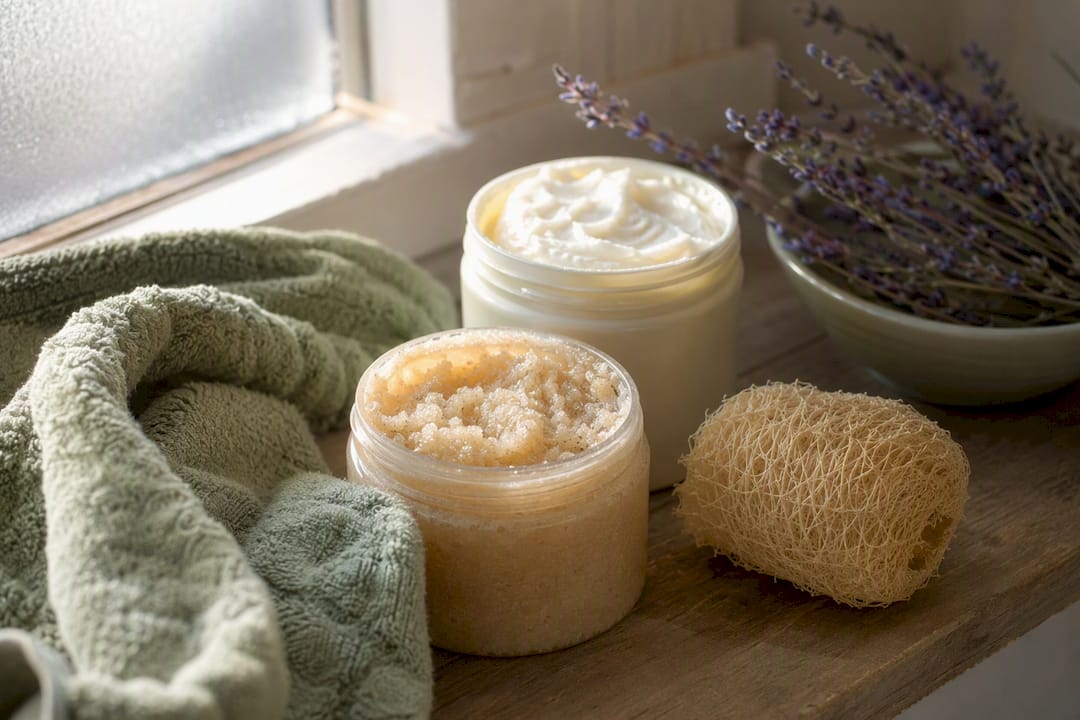
Everyone’s skin responds a little differently, so treat the guidance above as a starting point, not a rulebook. Start gentle, watch how your skin reacts over a week or two, and adjust frequency from there. Jeffi’s sugar scrub is a good place to begin if you’re testing this routine for the first time.
— Jeffi
Building exfoliation into your shave day, the easy way
Jeffi’s sugar scrub is designed to be the gentle physical step in exactly the routine described above, fine enough for legs, arms, and sensitive areas, with none of the sharp particles that cause nicks and microtears.

Use a small amount in the shower, work it over freshly steamed skin in soft circles, then rinse fully before you shave. Once you’re done, smooth on Jeffi’s whipped body butter to replace moisture your skin just lost to both the scrub and the razor. If you want to build a full pre and post shave routine in one go, check out Jeffi’s sugar scrub and pair it with a lotion from the full product lineup to see what fits your skin best.
Sources
- How to Avoid Ingrown Hairs and Razor Burn, According to Dermatologists — Byrdie
- Should You Exfoliate Before or After Shaving? Here’s the Expert Answer for Men — The Manual
- Exfoliate Before or After Shaving? Your Essential Skincare Guide — Dove
- Safely exfoliate at home — American Academy of Dermatology (AAD)