

Yes, essential oils can cause real skin sensitivity, including irritation, allergic contact dermatitis, and sun-triggered phototoxic reactions. Certain constituents, like linalool, limonene, and eugenol, are frequent culprits behind these reactions, and a “natural” label on a bottle tells you nothing about how your skin will respond to it. If you notice redness, itching, or a spreading rash after using a scented lotion or oil, stop use immediately and wash the area with soap and water. Seek urgent medical care right away if you notice swelling of the face or lips, or any trouble breathing.
Here’s what you’re dealing with and how to handle it:
- Irritation shows up fast, often within minutes to hours of contact.
- Allergic reactions typically take 24 to 72 hours to appear because your immune system needs time to respond.
- Phototoxic reactions only happen after sun exposure, sometimes hours or days later.
- Patch testing before regular use, and a dab of hydrocortisone for mild flare-ups, are two of the simplest tools for catching or calming a reaction early.
At Jeffi, we build our formulas around this reality rather than against it, which is why the rest of this guide walks through exactly what causes these reactions and how to use scented skincare with your eyes open.
Key Takeaways
Essential oil sensitivity in skincare happens through distinct, identifiable mechanisms, irritation, delayed allergic response, and phototoxicity, each with its own timeline and its own prevention strategy.
| Point | Details |
|---|---|
| Reactions have different timelines | Irritation appears within hours; allergic reactions take 24-72 hours; phototoxicity needs sun exposure to trigger. |
| Watch specific constituents | Linalool, limonene, eugenol, citral, and cinnamaldehyde are common sensitizers found in popular oils. |
| Oxidized oils are riskier | Old or improperly stored oils form peroxides that increase allergenicity, so discard anything smelling “off.” |
| Patch test the finished product | Test your actual lotion or serum, not just the raw oil, since formulation changes the allergen profile. |
| Choose gentler formulations | Jeffi’s lotions and body butters use clear labeling and lower fragrance loads for cautious, sensitive-skin trials. |
This article is general information, not a substitute for advice from a qualified doctor. Consult a qualified healthcare professional about your own circumstances before acting on anything here.
Table of Contents
- Essential Oil Sensitivity in Skincare: Types of Reactions to Recognize
- Which Oils and Ingredients Trigger Skincare Essential Oil Reactions Most Often
- Why Natural Oils Sensitize Skin: The Chemistry Behind the Reaction
- How to Test Essential Oils and Use Them Safely
- What to Do When Skincare Essential Oil Reactions Happen
- Sensitive Skin and Essential Oils: Who’s Most at Risk
- Cross-Reactivity: Why One Allergy Can Signal Others
- Managing Chronic Essential Oil Allergies Long Term
- Choosing Hypoallergenic Skincare When You’re Sensitive
- Why Natural Skincare Sensitivity Issues Persist Despite ‘All-Natural’ Labels
- Balancing Real Benefits Against Real Risk
- Trying Gentle, Clearly Labeled Skincare From Jeffi
- Sources
Essential Oil Sensitivity in Skincare: Types of Reactions to Recognize
Not every red patch on your skin means the same thing, and knowing which type of reaction you’re looking at changes what you should do next.
Irritant contact dermatitis is the most common and least mysterious. It happens when an oil is simply too strong or too concentrated for your skin barrier to handle, and it can happen to anyone, allergic or not. You’ll usually see redness, stinging, or a burning sensation within minutes to a few hours of contact, right where the product touched your skin.

Allergic contact dermatitis works differently. This is a true immune response, and it takes your body time to mount one. Symptoms, think intense itching, blistering, or a rash that spreads beyond the original application site, typically surface 24 to 72 hours after exposure. That delay is exactly why so many people miss the connection between a new body butter and a rash that shows up two days later.
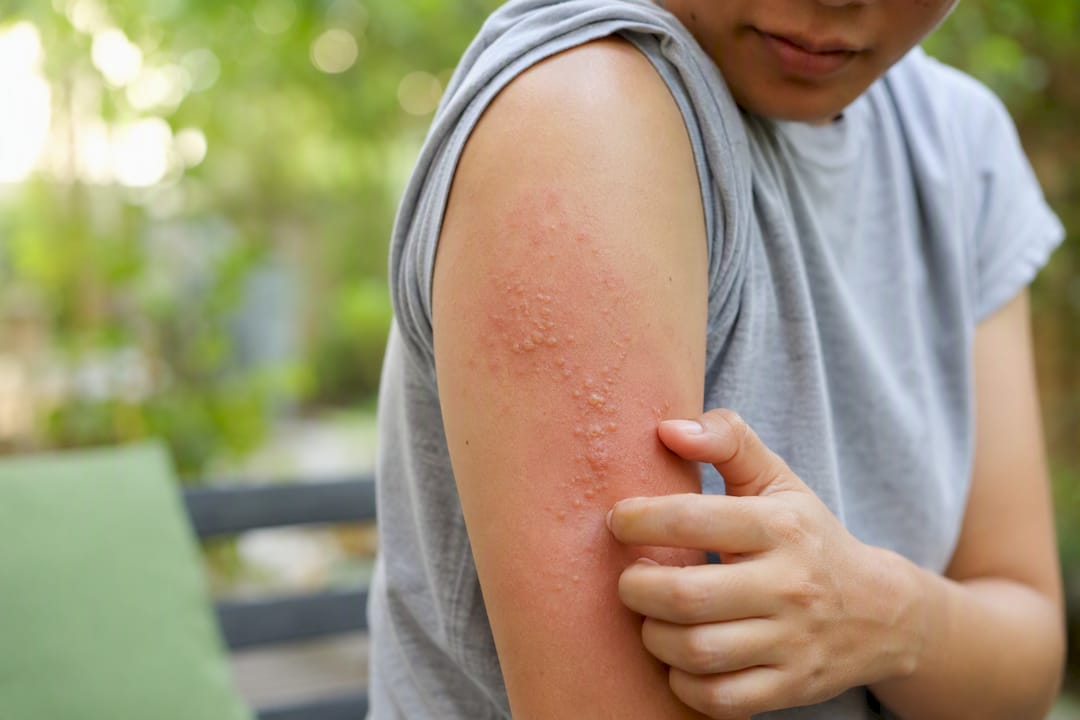
Contact urticaria is the fast one: raised, itchy welts (like hives) that appear almost immediately and often fade within hours.
Phototoxic reactions are the sneakiest of the four. Certain oils make your skin reactive to UV light, so nothing happens until you step into the sun, sometimes producing severe redness, blistering, and dark discoloration hours or days later.
Watch for these red flags that mean it’s time to stop self-managing and get medical attention:
- Blistering or open sores at the application site
- A rash spreading well beyond where you applied the product
- Facial or lip swelling
- Any difficulty breathing
- Signs of infection, including pus, warmth, or increasing pain days after the initial reaction
Which Oils and Ingredients Trigger Skincare Essential Oil Reactions Most Often
Some essential oils sensitize skin far more often than others, and dermatology research has flagged a consistent shortlist. Oils linked to allergic contact dermatitis most often include tea tree, lavender, ylang-ylang, peppermint, jasmine absolute, geranium, rose, sandalwood, and turpentine oils, alongside clove, lemongrass, and cinnamon-derived oils.
The real troublemakers are often specific molecules, not the oils themselves. Here’s what tends to drive essential oil allergies:
- Linalool — found in lavender and many florals; oxidizes readily into more allergenic byproducts over time.
- Limonene — common in citrus oils; also becomes more sensitizing as it ages and oxidizes.
- Eugenol — the compound behind clove’s distinctive scent, and a well-documented contact allergen.
- Citral — found in lemongrass and lemon-scented oils, tied to both irritation and allergic responses.
- Cinnamaldehyde — the primary irritant in cinnamon bark and cinnamon leaf oil, notorious for causing burns even in modest concentrations.
Absolutes, like jasmine absolute, deserve a special mention. Unlike steam-distilled essential oils, absolutes are extracted using solvents, which concentrates aromatic compounds far beyond what you’d find in nature. That concentration is part of why they smell incredible and part of why they carry higher sensitization risk.
Pro Tip: Check ingredient lists for the words “fragrance” or “natural fragrance.” Both terms can legally hide a mixture of dozens of aromatic compounds, including several of the sensitizers above, without disclosing a single one by name.
Why Natural Oils Sensitize Skin: The Chemistry Behind the Reaction
Sensitive skin and essential oils don’t mix well for reasons rooted in basic chemistry, not bad luck. Understanding the mechanism helps explain why a product you tolerated for months can suddenly start causing problems.
The biggest hidden risk is oxidation. Essential oils are volatile compounds that react with oxygen over time, forming peroxides and hydroperoxides that are far more allergenic than the fresh oil. This is why oxidation of essential oils is considered a genuine allergy risk factor, not just a quality issue.
Most delayed reactions happen through hapten formation. Small essential oil molecules, especially oxidized ones, bind to proteins in your skin. Your immune system doesn’t recognize this new combined molecule, treats it as a threat, and mounts a Type IV delayed hypersensitivity response, the same category of reaction behind poison ivy rashes. That’s also why symptoms take days rather than minutes to appear.
A few other factors stack the odds:
- Concentration and vehicle matter. Neat oil applied straight to skin, or a lotion with a heavy essential oil load, sensitizes faster than a well-diluted product.
- Repeated exposure raises risk over time, even at a dilution you tolerated once. Dilution and frequency are directly linked to risk, and long-term repeated use at higher concentrations increases sensitization chances even when each individual application seems fine.
- Quality varies wildly. Distillation method, growing conditions, and outright adulteration with cheaper synthetic compounds all affect how an oil behaves on skin, and two bottles labeled identically can behave completely differently.
How to Test Essential Oils and Use Them Safely
Most reactions are preventable with a few habits borrowed straight from dermatology practice. Here’s how to lower your risk without giving up scented skincare entirely.
- Stay diluted, always. Never apply undiluted essential oil directly to skin. Most safety guidance keeps leave-on facial products in the 0.5% to 2% range for adults, and lower for daily, whole-body use.
- Skip long-term high-percentage use. Even a diluted product used daily for months raises exposure and sensitization risk compared to occasional use.
- Store oils properly. Keep them in dark glass bottles, tightly capped, in a cool spot away from direct light. Oxidation happens faster in heat, light, and open air.
- Trust your nose. If a normally sweet oil starts smelling sharp, sour, or “off,” that’s often a sign it has oxidized into a more allergenic form. Toss it.
- Respect photosensitizing oils. Bergamot, lime, lemon, and other cold-pressed citrus oils can trigger phototoxic reactions after sun exposure, producing burns, blistering, or dark patches that weren’t caused by the sun alone. Avoid direct sun on treated skin for at least 12 hours after application.
- Patch test before regular use. Apply a small amount of the finished product, not just the raw oil, to your inner forearm and wait 48 hours before using it elsewhere.
- Consider dose escalation if you’re high-risk. For people with a history of skin allergies where professional testing isn’t practical, starting at around a 1% dilution and increasing gradually offers a lower-stakes way to check tolerance.
Pro Tip: Patch test the actual product you plan to use, not just the essential oil in isolation. Oxidation byproducts and formulation interactions are often the true allergen, and a raw-oil test can miss them entirely. A resource like Shella Bella Beauty’s patch-testing guide walks through the process step by step if you’ve never done one before.
What to Do When Skincare Essential Oil Reactions Happen
A reaction doesn’t have to turn into a crisis if you respond quickly and calmly.
The first move is always the same: stop using the product immediately. Gently wash the affected area with mild soap and water to remove any residual oil, and resist the urge to scrub, since friction can worsen irritation.
From there:
- Apply a fragrance-free moisturizer to support the skin barrier while it recovers.
- A short course of over-the-counter hydrocortisone cream can calm inflammation for mild to moderate reactions.
- Avoid other potential irritants (retinoids, exfoliating acids, additional fragranced products) until your skin fully calms down.
- Keep the area out of direct sunlight while it heals, especially if a citrus oil was involved.
Seek urgent medical attention if you develop facial swelling, difficulty breathing, large or spreading blisters, or signs of infection. These symptoms point to something beyond a routine local reaction and need prompt evaluation. Poison Control treats breathing difficulty after essential oil exposure as a genuine emergency, not a wait-and-see situation.
If reactions keep recurring across different products, that’s your cue to see a dermatologist about patch testing. Clinicians diagnose allergic contact dermatitis by applying small amounts of suspected allergens, ideally including your own products, to the skin under controlled conditions and checking results at 48 and 96 hours. Standard test panels sometimes miss allergens that only form once a product oxidizes, which is part of why testing your own product matters as much as testing the raw oil.
Sensitive Skin and Essential Oils: Who’s Most at Risk
Some people carry a higher baseline risk of essential oil allergies, and it’s worth knowing if you fall into one of these groups:
- Atopic dermatitis or eczema. A compromised skin barrier lets more allergenic compounds penetrate, raising sensitization odds substantially.
- A history of any topical allergy. Prior reactions to fragrance, preservatives, or metals suggest an immune system more prone to flagging new compounds as threats.
- Occupational exposure. Massage therapists, estheticians, and spa workers face frequent, cumulative contact that compounds risk over months and years.
- Children. Kids have thinner, more permeable skin, and certain oils, like wintergreen, camphor, and pennyroyal, carry serious toxicity risk if misused or overapplied on young skin.
Frequency matters as much as concentration. If you fall into any of these categories, fragrance-free or dermatologist-recommended formulations are the safer default, not an overcautious downgrade.
Cross-Reactivity: Why One Allergy Can Signal Others
If you’ve already reacted to one essential oil, you’re not necessarily safe with the others, and that’s a detail a lot of natural skincare marketing glosses over. Cross-reactivity happens when your immune system, having learned to recognize one allergenic compound, flags chemically similar molecules in a completely different product.
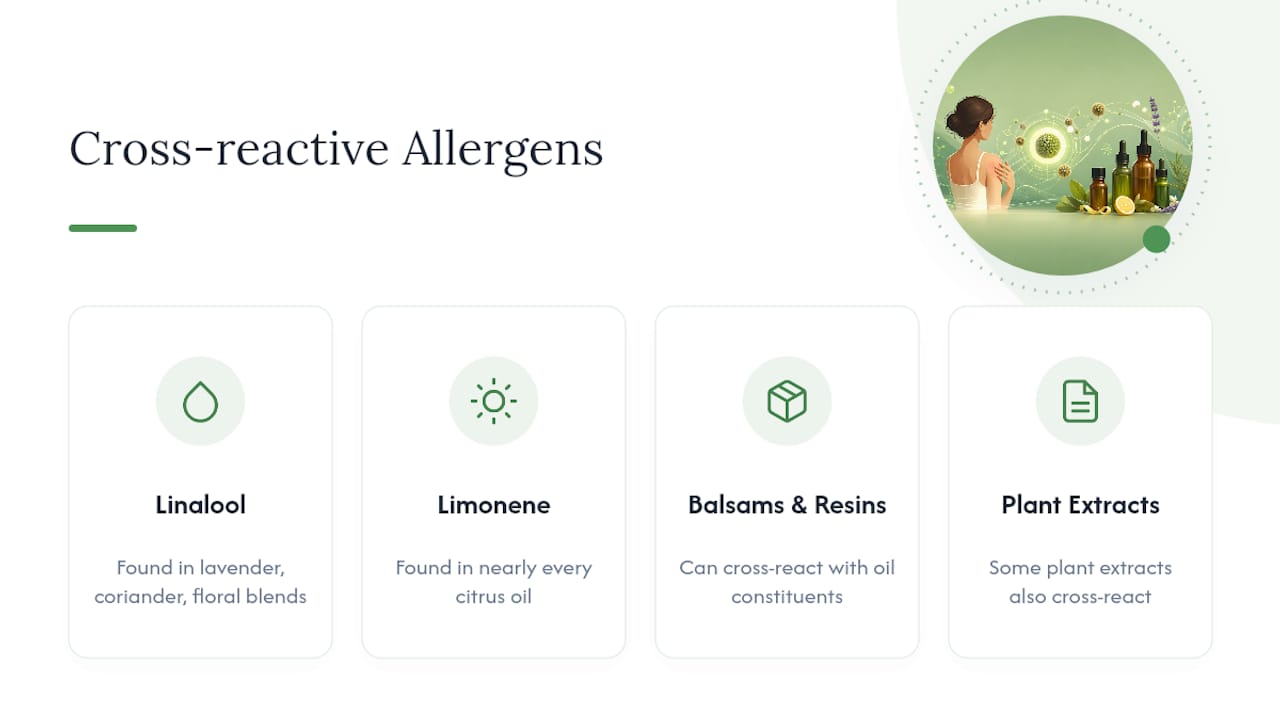
This matters practically because many essential oils share overlapping constituents. Linalool shows up in lavender, coriander, and several floral blends. Limonene appears in nearly every citrus oil on the market. If you’ve had a confirmed reaction to lavender, a “fragrance-free” claim on your next lotion isn’t the whole story, since that same linalool molecule could be present in a totally different scent profile under a synthetic or “nature-identical” label.
There’s also cross-reactivity between essential oil constituents and other well-known contact allergens, including certain balsams and resins used in fragrance compounds and even some plant-based skincare extracts. This is one reason dermatologists sometimes recommend broader fragrance avoidance, rather than just cutting out the one oil you suspect, once a person has confirmed one sensitivity.
The practical takeaway: after any confirmed reaction, read ingredient lists for the underlying chemical constituents, not just the plant name on the front label. A product that never lists lavender by name can still contain the exact compound that triggered your last reaction.
Managing Chronic Essential Oil Allergies Long Term
Chronic sensitivity to essential oils rarely resolves by simply switching products at random. It usually requires a more deliberate reset.
One practical approach for suspected multi-oil sensitization is a temporary total avoidance period, typically several weeks, of any essential oil or fragranced product, followed by careful single-oil reintroduction to identify exactly which compounds your skin tolerates and which it doesn’t. This avoidance-and-reintroduction method gives clearer answers than guessing your way through a shelf of “natural” products.
Beyond avoidance, long-term management usually rests on three habits. First, keep a running list of confirmed allergens after any dermatologist patch testing, and check every new product against it before buying. Second, favor fragrance-free formulations as your daily baseline, saving scented products for occasions where a reaction would be a minor inconvenience rather than a real setback. Third, treat flare-ups early with gentle, barrier-supporting moisturizers and short-term hydrocortisone rather than waiting them out.
For people managing eczema or another chronic skin condition alongside fragrance sensitivity, the two issues often feed each other. A damaged barrier lets more allergens in, and each reaction damages the barrier further. Breaking that cycle usually means committing to fragrance-free basics for weeks at a time, not days, before judging whether a new product is truly safe to add back.
Choosing Hypoallergenic Skincare When You’re Sensitive
Once you know your skin reacts to fragrance compounds, the safest strategy is picking products built around minimizing exposure in the first place, not just avoiding the one oil that burned you last time.
Look for a few concrete signals on the label. Fragrance-free (not simply “unscented,” which can still contain masking fragrance) is the strongest indicator. Short ingredient lists tend to carry lower cross-reactivity risk than complex blends with a dozen botanical extracts. And products that name specific ingredients rather than hiding behind “fragrance” or “parfum” let you actually check for known allergens like linalool or limonene before you buy.
Hypoallergenic doesn’t mean bland or ineffective. Plenty of moisturizing ingredients, shea butter, glycerin, ceramides, do real work without carrying essential oil sensitization risk. The trade-off is usually scent, not performance, so if you’re used to heavily fragranced lotions, expect an adjustment period rather than a downgrade.
If you’re unsure where a product lands, reviewing how fragrance ingredients are categorized can help you understand what’s actually in a scented formula before it touches your skin.
Why Natural Skincare Sensitivity Issues Persist Despite ‘All-Natural’ Labels
“Natural” is a marketing word, not a safety certification, and that gap causes more skin reactions than most shoppers realize. Essential oils are genuinely complex chemical mixtures, often containing dozens of distinct aromatic compounds in a single oil, and that complexity is precisely what makes them unpredictable on skin.
Two bottles of the same oil, harvested a season apart or distilled with different equipment, can carry meaningfully different allergen loads. Variability in harvesting, distillation, and overall product quality means a “natural” claim tells you almost nothing about what’s actually sensitizing your skin, or how much of it is present.
Adding to the confusion, essential oils used in skincare aren’t subject to the same premarket ingredient regulation as drugs in the United States. The FDA doesn’t test or approve individual essential oil batches for skin safety before they reach store shelves, which means quality control largely falls on the manufacturer’s own standards, not a government checkpoint. That’s not necessarily a red flag on its own, but it does mean the words “all-natural” carry less built-in reassurance than they sound like they should.
None of this means essential oils are inherently dangerous. It means natural skincare sensitivity issues deserve the same scrutiny you’d give any active ingredient, checking concentration, checking your own patch test results, and not assuming a botanical origin equals a guaranteed gentle experience.
Balancing Real Benefits Against Real Risk
Essential oils earn their popularity honestly. They smell wonderful, and some have genuine skin benefits when formulated with care. Dismissing them outright ignores how many people use them safely every day.
The mistake is treating “natural” as a substitute for caution. Careful, tested use, patch testing your actual products, respecting dilution limits, storing oils properly, catches nearly every reaction before it becomes a real problem. If you have a history of skin allergies, professional patch testing is worth the appointment.
Essential oil sensitivity in skincare isn’t a reason to avoid scented products entirely. It’s a reason to test before you commit, and to treat a fragrant lotion with the same respect you’d give any other active skincare ingredient.
— Jeffi
Trying Gentle, Clearly Labeled Skincare From Jeffi
If you’re wary of scented products after reading all this, you’re exactly the customer we built Jeffi for. Our whipped body butters, non-DEET mosquito repellents, and hand and body lotions are formulated with lower fragrance loads and clear ingredient labeling, so you’re never guessing what’s hiding behind a vague “fragrance” listing.

We recommend the same cautious approach with our products that this article laid out for any scented skincare: patch test a small amount first, start with a trial size before committing to a full-size product, and introduce anything new one item at a time so you know exactly what’s working for your skin. Our non-GMO certified lotions and body care line is a good place to start if you want moisture and bug protection without the guesswork of an unlabeled fragrance blend. Browse the full lineup and pick a trial size to test on your own skin before committing to a full routine.
Sources
- Allergic contact dermatitis to essential oils — DermNet NZ
- Essential oils: Poisonous when misused | Poison Control
- Essential Oils Debunked: Separating fact from myth | MDedge
- Irritation and allergic reactions - Tisserand Institute