

Short answer: no, coffee grounds are not a proven way to prevent mosquito bites. Lab research shows coffee extracts can make egg-laying sites less appealing to mosquitoes and can hurt larval development, but that is a breeding-site effect, not adult repellency. Burning grounds might disrupt mosquitoes briefly through smoke, not through any coffee-specific chemical. If you actually want to stop bites tonight, an EPA-registered repellent and a little yard cleanup will outperform any coffee trick.
TL;DR:
- Coffee grounds do not reliably prevent adult mosquito bites, as lab evidence shows they mainly impact breeding sites, not host-seeking behavior.
- Burning coffee grounds might briefly disrupt mosquitoes through smoke, but this effect is short-lived and should be approached with safety precautions.
- Using EPA-registered repellents containing DEET, picaridin, or oil of lemon eucalyptus remains the most effective and proven method for mosquito bite prevention.
- Sprinkling or steeping coffee grounds has minimal impact in real-world outdoor environments and should not replace source reduction or proven repellents.
- Combining yard hygiene, physical barriers, and EPA-registered repellents provides the best protection against mosquito bites and mosquito-borne illnesses.
Table of Contents
- Do Coffee Grounds Repel Mosquitoes? The Three Methods People Try
- What Does the Research Actually Show?
- Is It Safe to Try Burning or Sprinkling Coffee Grounds?
- Coffee Grounds vs. Proven Mosquito Protection
- Jeffi’s Take on Natural Mosquito Control
- How to Try Burning Coffee Grounds Safely (Plus Better Options)
- Why the Coffee-Grounds Hack Persists Despite Weak Evidence
- Jeffi’s Natural Way to Handle the Bites You Still Get
- Sources
- FAQ
Do Coffee Grounds Repel Mosquitoes? The Three Methods People Try
Search “coffee grounds mosquito repellent” and you’ll find three completely different DIY approaches lumped together as if they’re the same hack. They aren’t, and mixing them up is exactly why so much confusion exists around this topic.
- Burning dry grounds in a bowl or can to produce smoke, hoping it drives away adult mosquitoes nearby.
- Sprinkling dry grounds around patios, gardens, or potted plants, hoping the scent or texture keeps bugs off.
- Steeping grounds in water to make a concentrated “coffee water,” then setting it in containers where mosquitoes might lay eggs.
Each targets a different biological process. Smoke would, in theory, mask the carbon dioxide and body heat mosquitoes use to find you. Dry grounds scattered on soil have no clear mechanism at all. Steeped coffee extract is the only version with real lab backing, and that backing applies to egg-laying and larval survival, not to whether an adult mosquito bites your arm.
Pro Tip: If you see a claim about “coffee grounds for garden pests” or bugs in potted soil, check whether it’s talking about ants and gnats rather than mosquitoes. The pest and the mechanism both matter.
What Does the Research Actually Show?
The strongest evidence on this topic comes from a 2015 study published in Parasites & Vectors, which tested coffee extracts and coffee waste against Aedes albopictus, the Asian tiger mosquito. Researchers found that concentrated coffee extracts made water containers less attractive to gravid (egg-carrying) females, and reduced hatching and embryo development among the eggs that were laid.
What the data really measured: oviposition deterrence and larval toxicity in a controlled lab setting, not whether an adult mosquito would still land on exposed skin nearby.
That distinction matters because most people asking whether coffee grounds repel mosquitoes want to know if they’ll stop getting bitten, and no published field study answers that question with a yes. Experts at Virginia Tech have pointed out that spent grounds scattered around a yard likely have minimal real-world effect, and no research supports the idea that burning coffee grounds mosquitoes away actually works outside of a possible, short-lived smoke effect.
Is It Safe to Try Burning or Sprinkling Coffee Grounds?
If you’re still tempted to try it, the mechanism worth understanding is smoke, not coffee chemistry. Smoke can interfere with how mosquitoes track carbon dioxide and heat, which might explain why some people notice fewer bites near a smoldering bowl of grounds. That effect fades fast outdoors, since wind and open space scatter smoke within minutes.
A few safety points matter more than most articles admit:
- Use a heat-resistant, non-flammable container. Never burn grounds on a wooden deck, in dry grass, or near overhanging branches.
- Stay with it the entire time it burns. Smoldering coffee grounds still count as an open flame risk under most local fire codes.
- Keep the amount small. There’s no established burn size or duration that reliably creates a “protection zone.”
- Never dump steeped coffee water into gutters, ponds, birdbaths, or storm drains. Uncontrolled dumping can create new standing water problems instead of solving mosquito issues, since it disrupts natural water chemistry and can harm aquatic life.
Pro Tip: Sprinkling used grounds into shaded flowerpots or saucers can trap moisture and accidentally create a tiny breeding site. If you compost coffee grounds, keep that pile away from anywhere water collects.
Coffee Grounds vs. Proven Mosquito Protection
Here’s the real comparison homeowners need: a household hack with no field testing versus a set of tools that have gone through actual efficacy review. The CDC recommends EPA-registered insect repellents containing DEET, picaridin, IR3535, oil of lemon eucalyptus, or PMD, along with permethrin-treated clothing, window screens, fans on porches, and removing standing water weekly.
EPA registration means a product’s active ingredient has been evaluated for effectiveness and safety when used as labeled, something no coffee-grounds method has undergone. The CDC is explicit that non-EPA-registered “natural” repellents come with unknown effectiveness, which is a fair way to describe the coffee-grounds situation.
So when does a coffee trick make sense? Treat it as backyard novelty for a slow evening, not disease protection. If you’re in an area with real mosquito-borne illness risk, hosting a big outdoor gathering, or dealing with heavy mosquito pressure after rain, lean on proven yard habits and labeled repellents instead of a bowl of smoldering grounds.

Jeffi’s Take on Natural Mosquito Control
Jeffi has spent years writing about how mosquitoes find people in the first place, from body heat and carbon dioxide to the yard habits that quietly turn a patio into a breeding ground. That background shapes how we think about hacks like coffee grounds: interesting, occasionally useful at the margins, but never a replacement for source reduction.
Natural DEET-free topical products can be used alongside proven prevention methods, not instead of them. A natural repellent belongs on your skin. Standing water removal, screens, and fans belong in your yard. Coffee grounds, if you use them at all, belong in the “maybe helps a little, definitely won’t hurt to try” category. That’s a smaller claim than most articles make, and it’s the honest one.
How to Try Burning Coffee Grounds Safely (Plus Better Options)
If you want to test the smoke method anyway, here’s how to do it without creating a bigger problem than mosquitoes:
- Use fully dried, used coffee grounds. Wet grounds smolder poorly and produce more irritating smoke.
- Place them in a heat-resistant metal bowl or fire pit, never directly on wood, fabric, or dry vegetation.
- Clear a two-foot radius of anything flammable and keep a hose or extinguisher nearby.
- Watch it the entire time and let it burn out completely before walking away.
Pro Tip: Skip the smoke altogether and light a citronella candle instead. It’s steadier, safer around kids and pets, and doesn’t rely on wind conditions to work.
Remember that any smoke-based deterrent is temporary and largely useless in open, breezy spaces. For anything longer than a few minutes outside, an EPA-registered repellent on exposed skin will do far more than a bowl of grounds ever could.
Why the Coffee-Grounds Hack Persists Despite Weak Evidence
The coffee-grounds idea survives online because it has just enough real science attached to sound credible. A legitimate, peer-reviewed study exists. It just doesn’t say what most headlines claim it says. That gap between “a study found something” and “this study proves my backyard trick works” is where a lot of natural mosquito repellent advice quietly falls apart.
What the evidence actually supports is narrower and more useful than the popular version: coffee waste can interfere with mosquito breeding under controlled conditions, and smoke from any burning material can briefly disrupt adult host-seeking behavior. Neither finding justifies treating a bag of used grounds as a substitute for repellent on your skin.
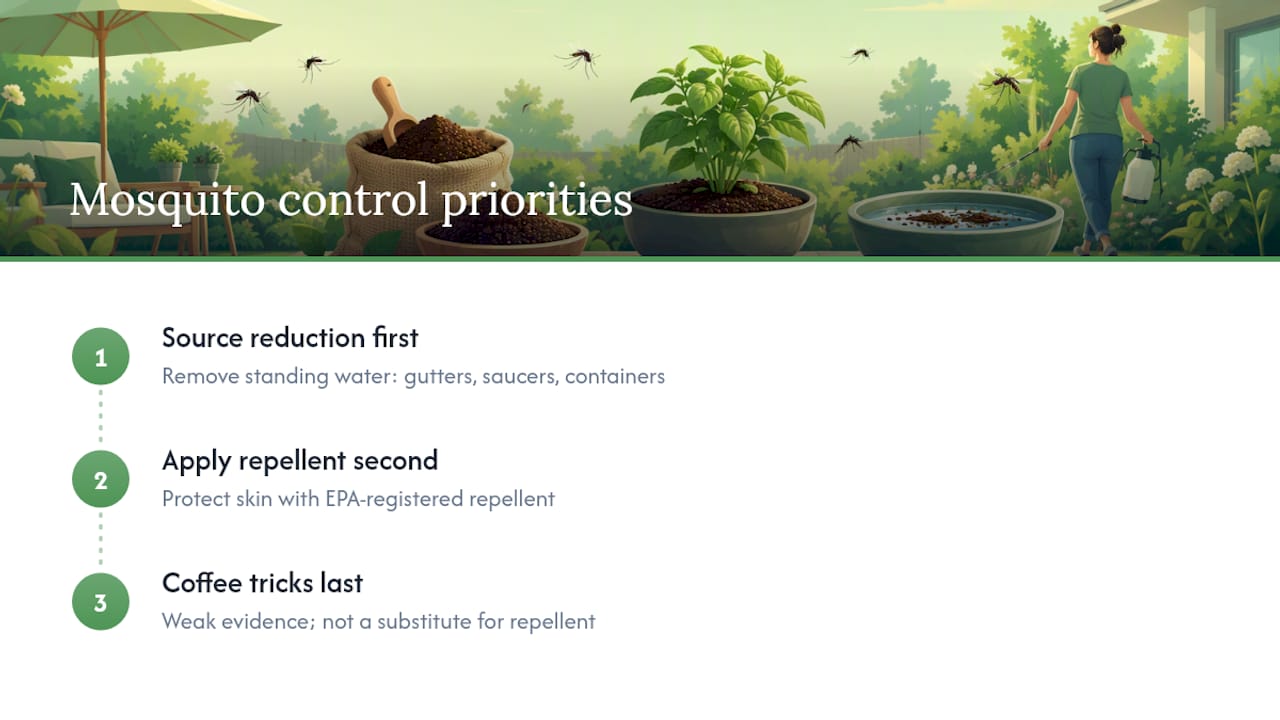
If there’s one thing worth prioritizing, it’s sequencing. Handle source reduction first (standing water, gutters, plant saucers), apply a real repellent second, and treat coffee-based tricks as an afterthought at best. Readers who flip that order, leading with the hack and skipping the basics, are the ones who end up disappointed at their own barbecue.
— Jeffi
Jeffi’s Natural Way to Handle the Bites You Still Get
Even with screens, fans, and a spotless yard, a few mosquitoes usually get through. That’s where Jeffi fits in differently than a smoke bowl or a sprinkle of grounds ever could: our DEET-free, Non-GMO certified formulas are made for the moment prevention isn’t enough.

Natural topical options can be applied to exposed skin before heading outside to complement recommended prevention steps as outlined in Skin Booster Aftercare: Essential Tips for Best Results. Some relief products help calm itch and irritation without synthetic chemicals, providing a natural option. Use Mosquito Bee Gone™ for prevention on skin, keep up with yard habits for the bigger picture, and reach for the Bug Bite Relief Balm the moment a bite starts to itch. Ready to stock up before your next backyard evening? Browse the Bug Bite Relief collection and get something proven in your bag instead of a bowl of smoldering grounds.
Sources
- Do Coffee Grounds Repel Mosquitoes? Here’s What Actually Works
- Preventing Mosquito Bites | Mosquitoes | CDC
FAQ
Do coffee grounds repel mosquitoes?
Not in any proven way. Lab research shows coffee extracts can deter egg-laying and harm larval development in controlled water-based tests, but no field study shows sprinkling or burning grounds stops adult mosquitoes from biting.
What smells do mosquitoes hate the most?
Mosquitoes tend to avoid strong scents like citronella, eucalyptus, and lemongrass, along with the labeled active ingredients in EPA-registered repellents such as DEET and picaridin. The CDC notes that natural, non-EPA-registered scents have unknown real-world effectiveness compared to registered products.
What does sprinkling coffee grounds around your house actually do?
It mostly does very little for adult mosquitoes. Coffee grounds pest control claims largely arise from lab research involving concentrated extracts in water; this effect does not apply to dry grounds scattered in a typical yard.
What is the best homemade mosquito repellent?
If you want a natural repellent with a formulated purpose rather than a kitchen improvisation, a DEET-free product like Jeffi’s Mosquito Bee Gone™ is built specifically for skin application, unlike coffee grounds or other DIY mixtures.
Do Folgers coffee grounds keep mosquitoes away better than other brands?
There’s no evidence that any specific coffee brand, including Folgers, performs differently than another. The research behind coffee’s effect on mosquitoes involves concentrated extracts and waste material studied under lab conditions, not brand-name grounds used straight from the bag.